
In January 1872, Bryant traveled to Mexico City, where he was greeted warmly by President Benito Juarez; on this and other occasions he was feted for the Evening Post's sturdy condemnation in 1863 of the abortive invasion of Mexico, which was freshly remembered there. AT the close of his visit a local newspaper remarked that the "honors and hospitality which were so lavishly and generously conferred upon him were the spontaneous outpouring of a grateful people, who had not forgotten that when Mexico was friendless Mr. Bryant became her friend." Returning in April through New Orleans and up the Mississippi by steamboat to Cincinnati, he was greeted at a public reception by Governor Rutherford Hayes, who was pleased by his "winning and lovable" manners and "pithy" anecdotes.
That spring Bryant built a library for his birthplace, Cummington, stocking it with several thousand books procured for him by the publisher George Palmer Putnam in New York and London. The following year, after the last of his many travels - this time a revisit to South Carolina and Florida - he made a similar gift to Roslyn. These benefactions won him honorary membership in the newly formed American Library Association, and an invitation to open a library at Princeton University, which made him an honorary doctor of letters. Ultimately, in the final year of his life, his plans for the Bryant Library at Cummington, solicited from the White House by President Hayes, provided the basic design for the first presidential library in the country - that established by Hayes in Fremont, Ohio.
An improbable by-product of the presidential race in 1872 was a proposal by leading journalists that Bryant become -in his seventy-eighth year - a candidate to oppose President Grant and his challenger for the Republican nomination, the mercurial editor of the New York Tribune, Horace Greeley. Bryant's immediate refusal to take the suggestion seriously was succinct, and tinged with humor. It was impossible, he declared in his newspaper, that he should receive the nomination, and "equally impossible," if it were offered, that he should "commit the folly of accepting it." Four years later he was distressed at being unable to switch his journal's support of the Republican candidate Hayes to the Democratic candidate, his old companion in political reform, Samuel Jones Tilden.
As Bryant approached and entered his eighties, his writing and public speaking continued without slackening. Between 1872 and 1878 he published his collected Orations and Addresses, edited a revision of his anthology of poetry and two volumes of landscape sketches, Picturesque America, co-authored a four-volume Popular History of the United States, and undertook to co-edit a three-volume set of Shakespeare's plays, while also producing long monographs on several seventeenth-century English poets. He dedicated statues of Shakespeare, Walter Scott, and Fitz-Green Halleck in Central Park, and spoke elsewhere on Robert Burns, Benjamin Franklin, Goethe, and Shakespeare, gave speeches on Mexico and "National Honesty," and presided over the founding of the State Charities Aid Association. He was honored in Albany at receptions by each house of the legislature. For his eightieth birthday, his life's work was celebrated in silver on a Tiffany vase given him by admirers throughout the country.
Bryant's last public act was to unveil, in Central Park, his brainchild of nearly a half century earlier: a bust of the Italian patriot Giuseppe Mazzini. Here, after exhaustion under the June sun, he fell and suffered a massive concussion followed by a stroke, which led to his death a fortnight later in his eighty-fourth year. A period of virtual national mourning preceded his funeral and his burial beside his wife at Roslyn. At one of many memorial services, a eulogist exclaimed, "The broad outline of his character had become universally familiar, like a mountain or a sea. Whoever saw Bryant saw America."
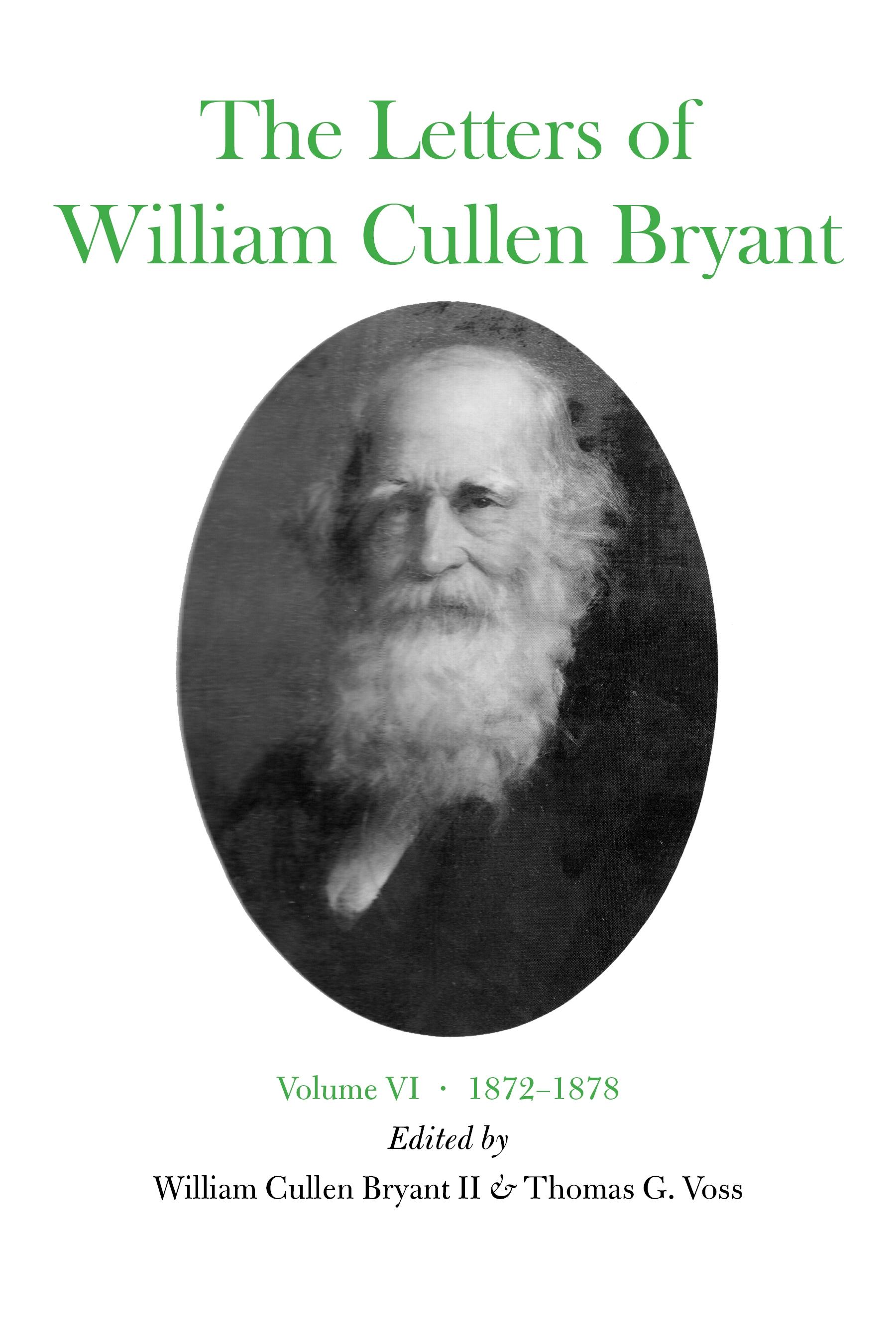
The Letters of William Cullen Bryant: Volume VI, 1872–1878 is available from the publisher on an open-access basis.
Pay easily by card, Klarna, Apple Pay or Google Pay. Not happy? You always have a 14-day money-back guarantee. Read more in our terms. If you have any questions, email us at hello@memmo.org.
Memmo makes studying easier – wherever you are in the world. We bring your course books and smart study tools together in one place: summaries, quizzes, podcasts and flashcards. Plus Ted, your study buddy who answers anything you wonder. Over 50,000 students already study here – built to help you learn faster and stress less.