
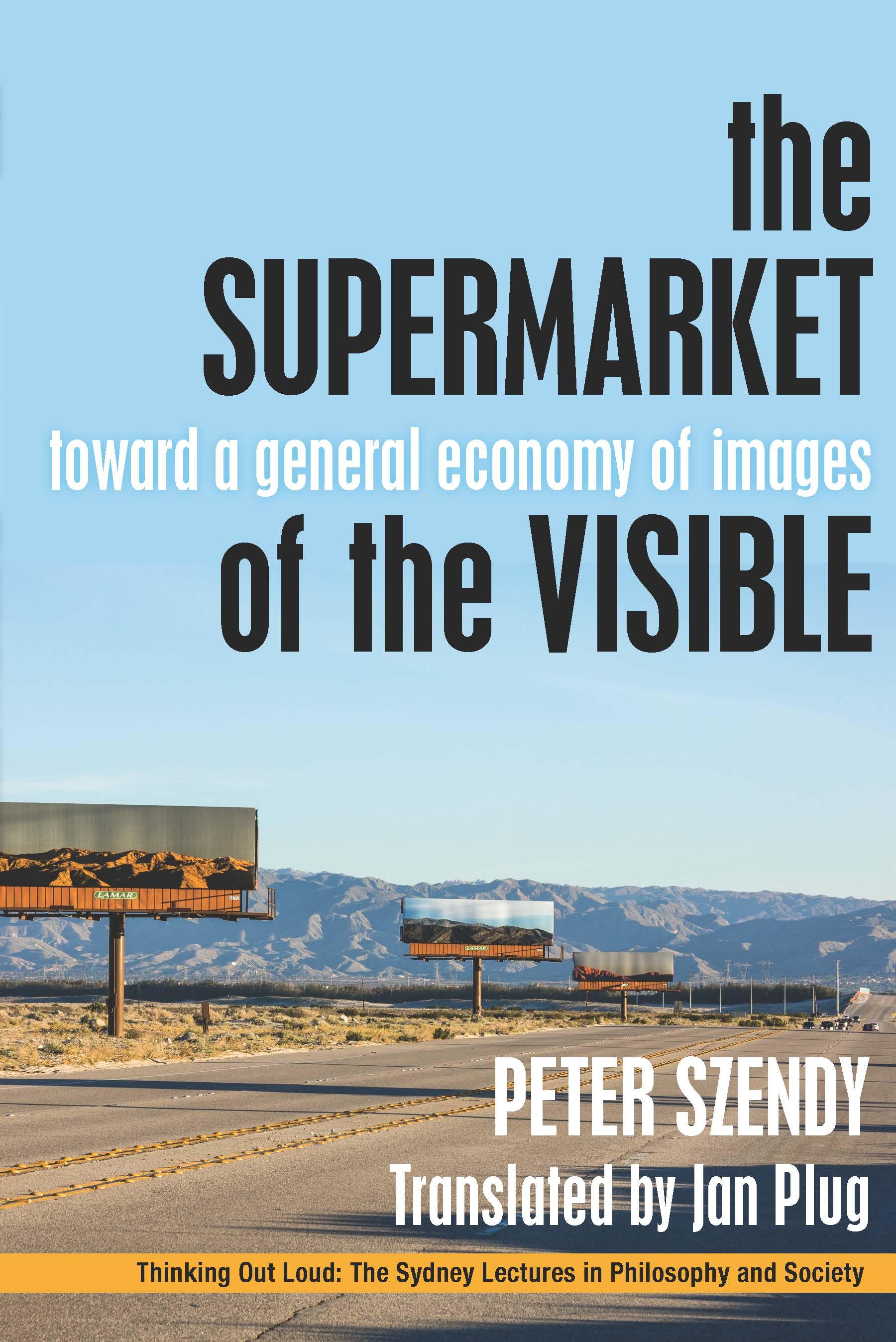
Already in 1929, Walter Benjamin described “a one hundred per cent image-space.” Such an image space saturates our world now more than ever, constituting the visibility in which we live. The Supermarket of the Visible analyzes this space and the icons that populate it as the culmination of a history of the circulation and general commodification of images and gazes. From the first elevators and escalators (tracking shots avant la lettre) to cinema (the great conductor of gazes), all the way down to contemporary eye-tracking techniques that monitor the slightest saccades of our eyes, Peter Szendy offers an entirely novel theory of the intersection of the image and economics.
The Supermarket of the Visible elaborates an economy proper to images, icons, in other words, an iconomy. Deleuze caught a glimpse of this when he wrote that “money is the back side of all the images that cinema shows and edits on the front.” Since “cinema,” for Deleuze, is synonymous with “universe,” Szendy argues that this sentence must be understood in its broadest dimension and that a reading of key works in the history of cinema allows us a unique vantage point upon the reverse of images, their monetary implications. Paying close attention to sequences in Hitchcock, Bresson, Antonioni, De Palma, and The Sopranos, Szendy shows how cinema is not a uniquely commercial art form among other, purer arts, but, more fundamentally, helps to elaborate what might be called, with Bataille, a general iconomy.
Moving deftly and lightly between political economy, aesthetic theory, and popular movies and television, The Supermarket of the Visible will be a necessary book for anyone concerned with media, philosophy, politics, or visual culture.
Pay easily by card, Klarna, Apple Pay or Google Pay. Not happy? You always have a 14-day money-back guarantee. Read more in our terms. If you have any questions, email us at hello@memmo.org.
Memmo makes studying easier – wherever you are in the world. We bring your course books and smart study tools together in one place: summaries, quizzes, podcasts and flashcards. Plus Ted, your study buddy who answers anything you wonder. Over 50,000 students already study here – built to help you learn faster and stress less.