
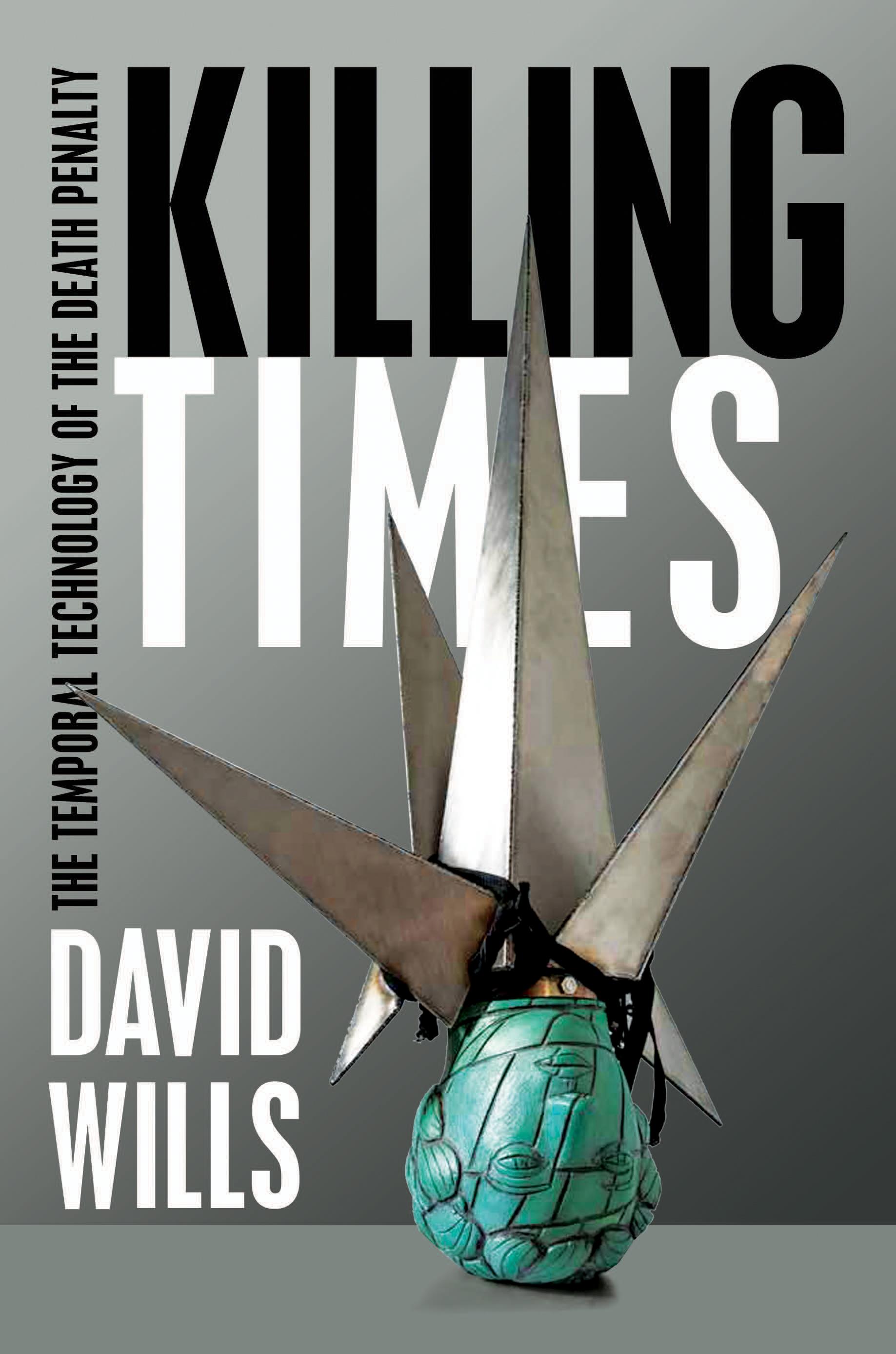
Killing Times begins with the deceptively simple observation—made by Jacques Derrida in his seminars on the topic—that the death penalty mechanically interrupts mortal time by preempting the typical mortal experience of not knowing at what precise moment we will die. Through a broader examination of what constitutes mortal temporality, David Wills proposes that the so-called machinery of death summoned by the death penalty works by exploiting, or perverting, the machinery of time that is already attached to human existence. Time, Wills argues, functions for us in general as a prosthetic technology, but the application of the death penalty represents a new level of prosthetic intervention into what constitutes the human.
Killing Times traces the logic of the death penalty across a range of sites. Starting with the legal cases whereby American courts have struggled to articulate what methods of execution constitute “cruel and unusual punishment,” Wills goes on to show the ways that technologies of death have themselves evolved in conjunction with ideas of cruelty and instantaneity, from the development of the guillotine and the trap door for hanging, through the firing squad and the electric chair, through today’s controversies surrounding lethal injection. Responding to the legal system’s repeated recourse to storytelling—prosecutors’ and politicians’ endless recounting of the horrors of crimes—Wills gives a careful eye to the narrative, even fictive spaces that surround crime and punishment.
Many of the controversies surrounding capital punishment, Wills argues, revolve around the complex temporality of the death penalty: how its instant works in conjunction with forms of suspension, or extension of time; how its seeming correlation between egregious crime and painless execution is complicated by a number of different discourses.
By pinpointing the temporal technology that marks the death penalty, Wills is able to show capital punishment’s expansive reach, tracing the ways it has come to govern not only executions within the judicial system, but also the opposed but linked categories of the suicide bombing and drone warfare. In discussing the temporal technology of death, Wills elaborates the workings both of the terrorist who produces a simultaneity of crime and “punishment” that bypasses judicial process, and of the security state, in whose remote-control killings the time-space coordinates of “justice” are compressed and at the same time disappear into the black hole of secrecy.
Grounded in a deep ethical and political commitment to death penalty abolition, Wills’s engaging and powerfully argued book pushes the question of capital punishment beyond the confines of legal argument to show how the technology of capital punishment defines and appropriates the instant of death and reconfigures the whole of human mortality.
Pay easily by card, Klarna, Apple Pay or Google Pay. Not happy? You always have a 14-day money-back guarantee. Read more in our terms. If you have any questions, email us at hello@memmo.org.
Memmo makes studying easier – wherever you are in the world. We bring your course books and smart study tools together in one place: summaries, quizzes, podcasts and flashcards. Plus Ted, your study buddy who answers anything you wonder. Over 50,000 students already study here – built to help you learn faster and stress less.