
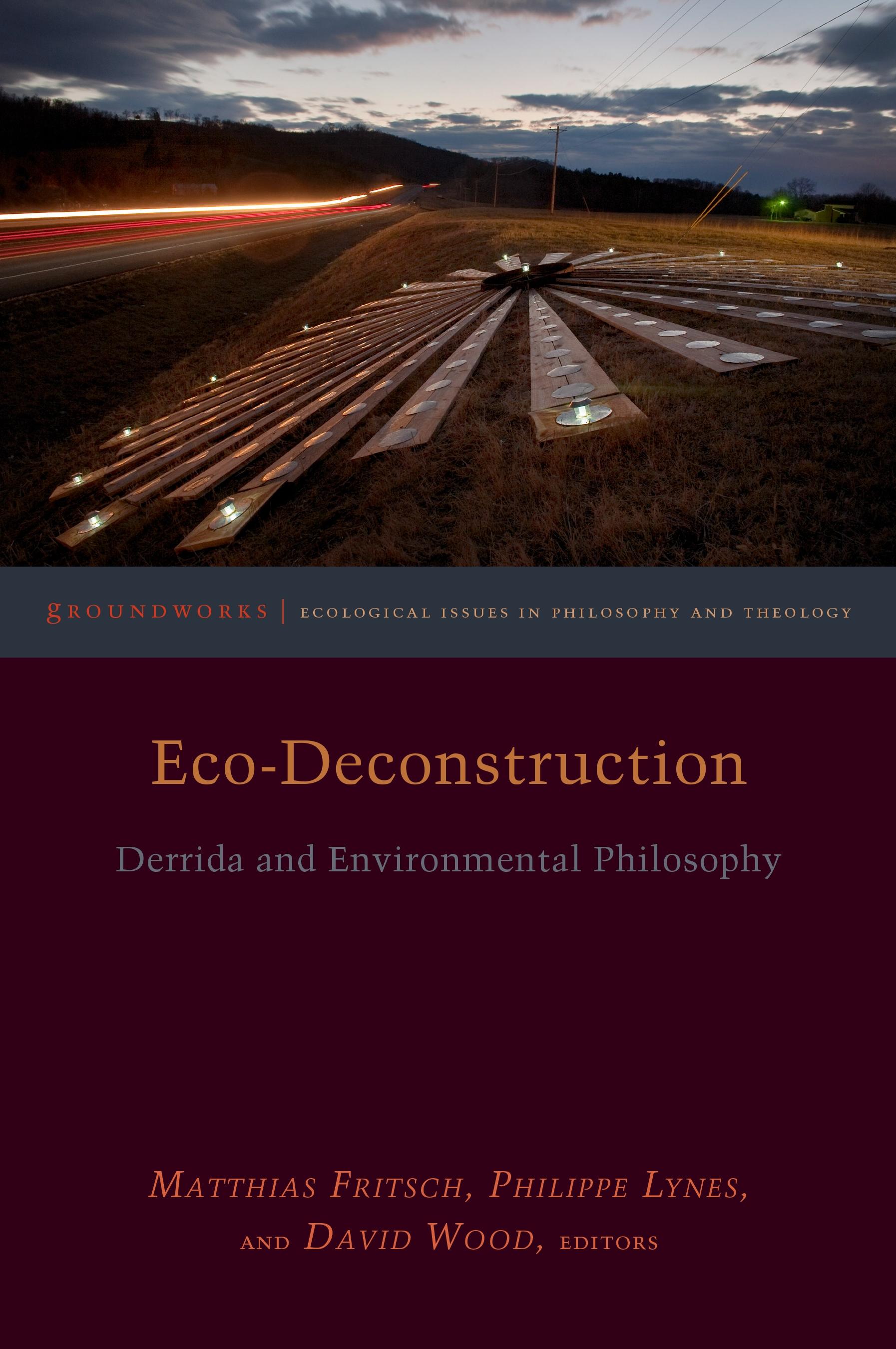
Eco-Deconstruction
Eco-Deconstruction marks a new approach to the degradation of the natural environment, including habitat loss, species extinction, and climate change. While the work of French philosopher Jacques Derrida (1930–2004), with its relentless interrogation of the anthropocentric metaphysics of presence, has already proven highly influential in posthumanism and animal studies, the present volume, drawing on published and unpublished work by Derrida and others, builds on these insights to address the most pressing environmental issues of our time.
The volume brings together fifteen prominent scholars, from a wide variety of related fields, including eco-phenomenology, eco-hermeneutics, new materialism, posthumanism, animal studies, vegetal philosophy, science and technology studies, environmental humanities, eco-criticism, earth art and aesthetics, and analytic environmental ethics. Overall, eco-deconstruction offers an account of differential relationality explored in a non-totalizable ecological context that addresses our times in both an ontological and a normative register.
The book is divided into four sections. “Diagnosing the Present” suggests that our times are marked by a facile, flattened-out understanding of time and thus in need of deconstructive dispositions. “Ecologies” mobilizes the spectral ontology of deconstruction to argue for an originary environmentality, the constitutive ecological embeddedness of mortal life. “Nuclear and Other Biodegradabilities,” examines remains, including such by-products and disintegrations of human culture as nuclear waste, environmental destruction, and species extinctions. “Environmental Ethics” seeks to uncover a demand for justice, including human responsibility for suffering beings, that emerges precisely as a response to original differentiation and the mortality and unmasterable alterity it installs in living beings. As such, the book will resonate with readers not only of philosophy, but across the humanities and the social and natural sciences.
Pay easily by card, Klarna, Apple Pay or Google Pay. Not happy? You always have a 14-day money-back guarantee. Read more in our terms. If you have any questions, email us at hello@memmo.org.
Memmo makes studying easier – wherever you are in the world. We bring your course books and smart study tools together in one place: summaries, quizzes, podcasts and flashcards. Plus Ted, your study buddy who answers anything you wonder. Over 50,000 students already study here – built to help you learn faster and stress less.