
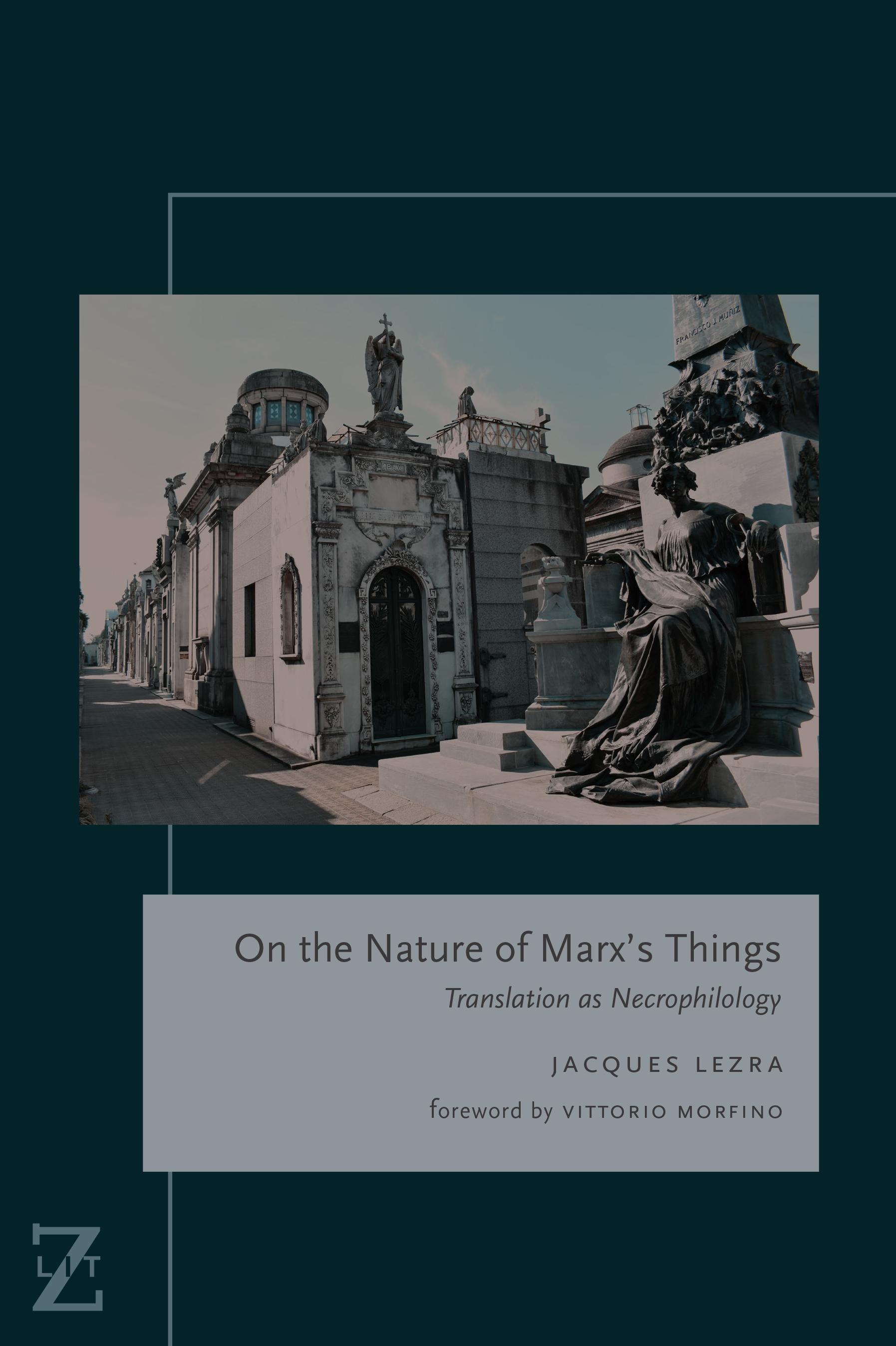
On the Nature of Marx’s Things is a major rethinking of the Marxian tradition, one based not on fixed things but on the inextricable interrelation between the material world and our language for it. Lezra traces to Marx’s earliest writings a subterranean, Lucretian practice that he calls necrophilological translation that continues to haunt Marx’s inheritors. This Lucretian strain, requiring that we think materiality in non-self-evident ways, as dynamic, aleatory, and always marked by its relation to language, raises central questions about ontology, political economy, and reading.
“Lezra,” writes Vittorio Morfino in his preface, “transfers all of the power of the Althusserian encounter into his conception of translation.” Lezra’s expansive understanding of translation covers practices that put different natural and national languages into relation, often across periods, but also practices or mechanisms internal to each language. Obscured by later critical attention to the contradictory lexicons—of fetishism and of chrematistics—that Capital uses to describe how value accrues to commodities, and by the dialectical approach that’s framed Marx’s work since Engels sought to marry it to the natural philosophy of his time, necrophilological translation has a troubling, definitive influence in Marx’s thought and in his wake. It entails a radical revision of what counts as translation, and wholly new ways of imagining what an object is, of what counts as matter, value, sovereignty, mediation, and even number.
In On the Nature of Marx’s Things a materialism “of the encounter,” as recent criticism in the vein of the late Althusser calls it, encounters Marxological value-form theory, post-Schmittian divisible sovereignty, object-oriented-ontologies and the critique of correlationism, and philosophies of translation and untranslatability in debt to Quine, Cassin, and Derrida. The inheritors of the problems with which Marx grapples range from Spinoza’s marranismo, through Melville’s Bartleby, through the development of a previously unexplored Freudian political theology shaped by the revolutionary traditions of Schiller and Verdi, through Adorno’s exilic antihumanism against Said’s cosmopolitan humanism, through today’s new materialisms.
Ultimately, necrophilology draws the story of capital’s capture of difference away from the story of capital’s production of subjectivity. It affords concepts and procedures for dismantling the system of objects on which neoliberal capitalism stands: concrete, this-wordly things like commodities, but also such “objects” as debt traps, austerity programs, the marketization of risk; ideologies; the pedagogical, professional, legal, even familial institutions that produce and reproduce inequities today.
Pay easily by card, Klarna, Apple Pay or Google Pay. Not happy? You always have a 14-day money-back guarantee. Read more in our terms. If you have any questions, email us at hello@memmo.org.
Memmo makes studying easier – wherever you are in the world. We bring your course books and smart study tools together in one place: summaries, quizzes, podcasts and flashcards. Plus Ted, your study buddy who answers anything you wonder. Over 50,000 students already study here – built to help you learn faster and stress less.