
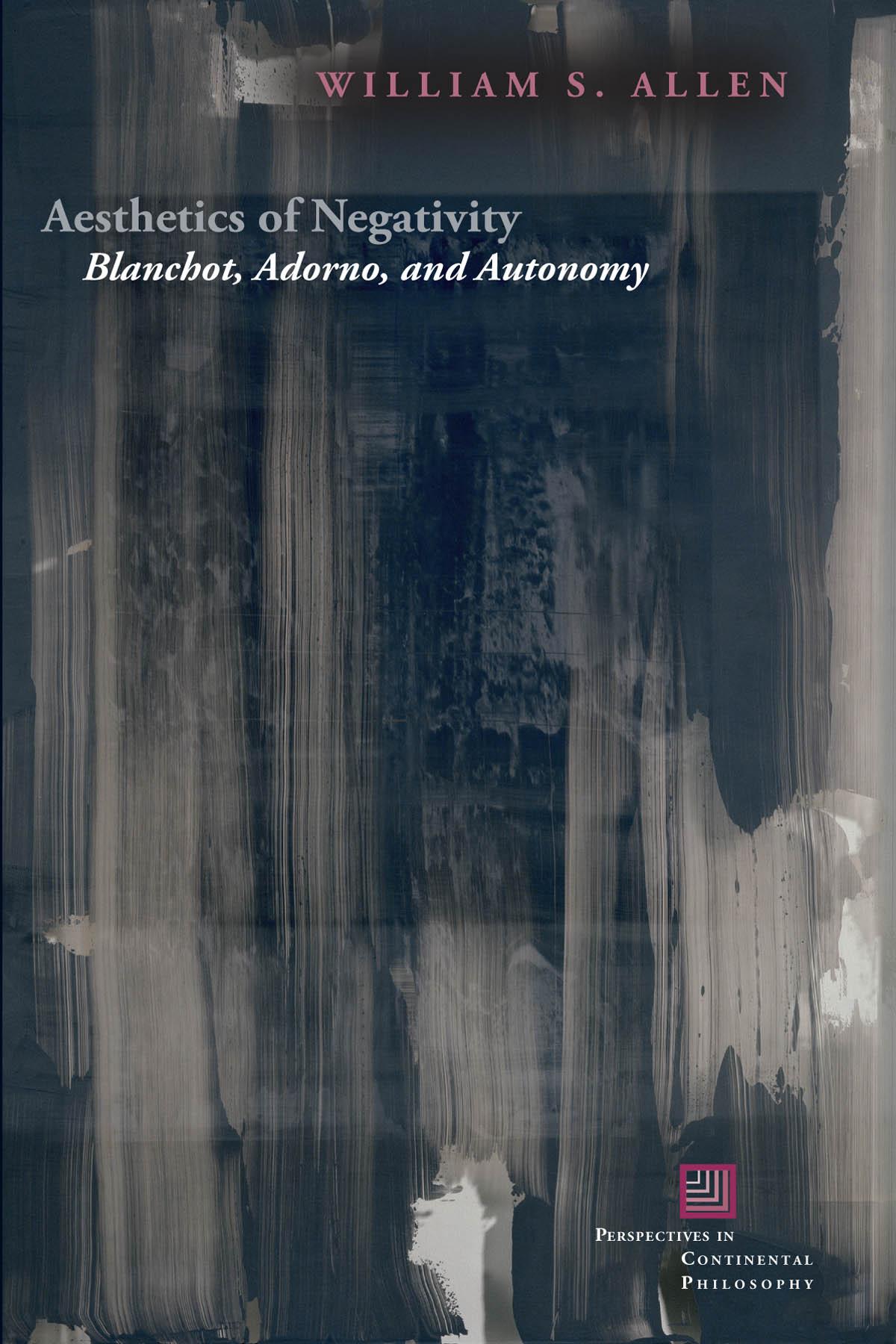
Maurice Blanchot and Theodor W. Adorno are among the most difficult but also the most profound thinkers in twentieth-century aesthetics. While their methods and perspectives differ widely, they share a concern with the negativity of the artwork conceived in terms of either its experience and possibility or its critical expression. Such negativity is neither nihilistic nor pessimistic but concerns the status of the artwork and its autonomy in relation to its context or its experience. For both Blanchot and Adorno negativity is the key to understanding the status of the artwork in post-Kantian aesthetics and, although it indicates how art expresses critical possibilities, albeit negatively, it also shows that art bears an irreducible ambiguity such that its meaning can always negate itself. This ambiguity takes on an added material significance when considered in relation to language as the negativity of the work becomes aesthetic in the further sense of being both sensible and experimental, and in doing so the language of the literary work becomes a form of thinking that enables materiality to be thought in its ambiguity.
In a series of rich and compelling readings, William S. Allen shows how an original and rigorous mode of thinking arises within Blanchot’s early writings and how Adorno’s aesthetics depends on a relation between language and materiality that has been widely overlooked. Furthermore, by reconsidering the problem of the autonomous work of art in terms of literature, a central issue in modernist aesthetics is given a greater critical and material relevance as a mode of thinking that is abstract and concrete, rigorous and ambiguous. While examples of this kind of writing can be found in the works of Blanchot and Beckett, the demands that such texts place on readers only confirm the challenges and the possibilities that literary autonomy poses to thought.
Pay easily by card, Klarna, Apple Pay or Google Pay. Not happy? You always have a 14-day money-back guarantee. Read more in our terms. If you have any questions, email us at hello@memmo.org.
Memmo makes studying easier – wherever you are in the world. We bring your course books and smart study tools together in one place: summaries, quizzes, podcasts and flashcards. Plus Ted, your study buddy who answers anything you wonder. Over 50,000 students already study here – built to help you learn faster and stress less.