
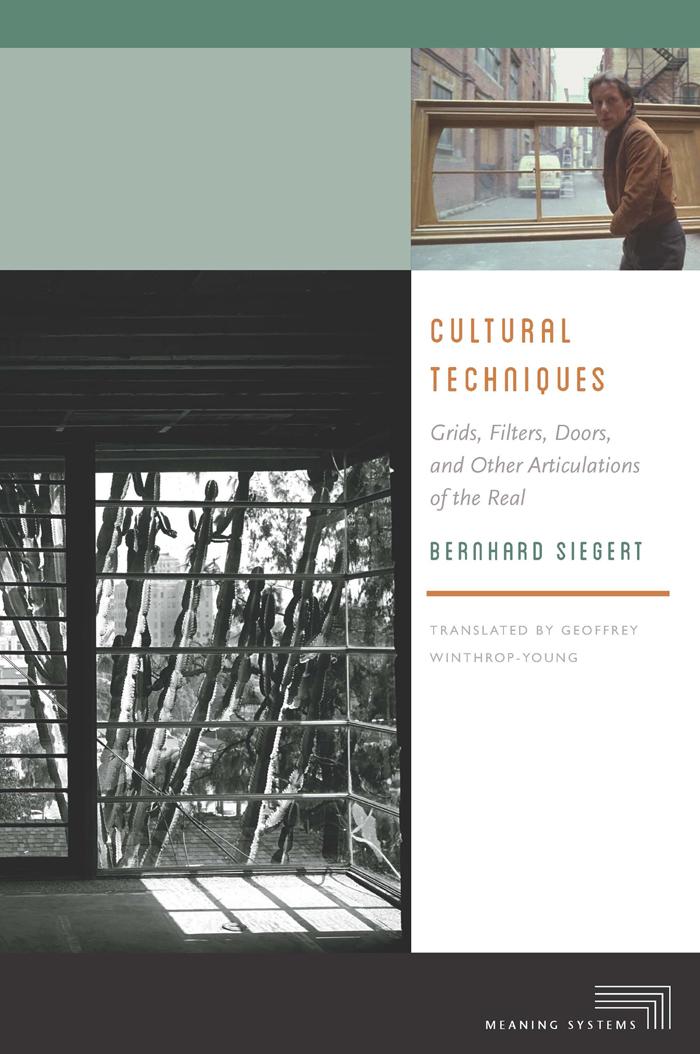
In a crucial shift within posthumanistic media studies, Bernhard Siegert dissolves the concept of media into a network of operations that reproduce, displace, process, and reflect the distinctions fundamental for a given culture. Cultural Techniques aims to forget our traditional understanding of media so as to redefine the concept through something more fundamental than the empiricist study of a medium’s individual or collective uses or of its cultural semantics or aesthetics. Rather, Siegert seeks to relocate media and culture on a level where the distinctions between object and performance, matter and form, human and nonhuman, sign and channel, the symbolic and the real are still in the process of becoming. The result is to turn ontology into a domain of all that is meant in German by the word Kultur.
Cultural techniques comprise not only self-referential symbolic practices like reading, writing, counting, or image-making. The analysis of artifacts as cultural techniques emphasizes their ontological status as “in-betweens,” shifting from firstorder to second-order techniques, from the technical to the artistic, from object to sign, from the natural to the cultural, from the operational to the representational.
Cultural Techniques ranges from seafaring, drafting, and eating to the production of the sign-signaldistinction in old and new media, to the reproduction of anthropological difference, to the study of trompe-l’oeils, grids, registers, and doors. Throughout, Siegert addresses fundamental questions of how ontological distinctions can be replaced by chains of operations that process those alleged ontological distinctions within the ontic.
Grounding posthumanist theory both historically and technically, this book opens up a crucial dialogue between new German media theory and American postcybernetic discourses.
Pay easily by card, Klarna, Apple Pay or Google Pay. Not happy? You always have a 14-day money-back guarantee. Read more in our terms. If you have any questions, email us at hello@memmo.org.
Memmo makes studying easier – wherever you are in the world. We bring your course books and smart study tools together in one place: summaries, quizzes, podcasts and flashcards. Plus Ted, your study buddy who answers anything you wonder. Over 50,000 students already study here – built to help you learn faster and stress less.