
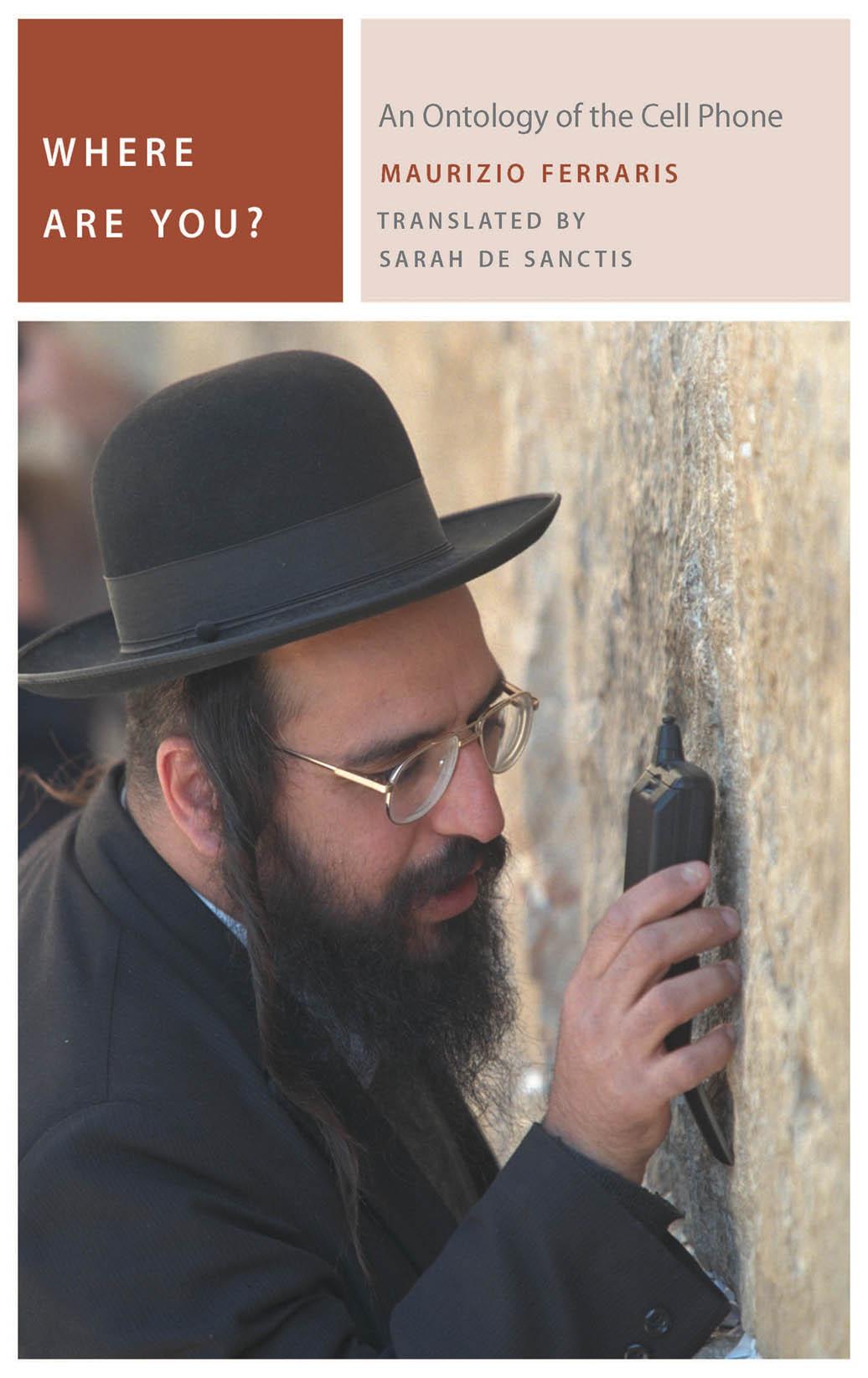
This book sheds light on the most philosophically interesting of contemporary objects: the cell phone. “Where are you?”—a question asked over cell phones myriad times each day—is arguably the most philosophical question of our age, given the transformation of presence the cell phone has wrought in contemporary social life and public space.
Throughout all public spaces, cell phones are now a ubiquitous prosthesis of what Descartes and Hegel once considered the absolute tool: the hand. Their power comes in part from their ability to move about with us—they are like a computer, but we can carry them with us at all times—in part from what they attach to us (and how), as all that computational and connective power becomes both handy and hand-sized.
Quite surprisingly, despite their name, one might argue, as Ferraris does, that cell phones are not really all that good for sound and speaking. Instead, the main philosophical point of this book is that mobile phones have come into their own as writing machines—they function best for text messages, e-mail, and archives of all
kinds. Their philosophical urgency lies in the manner in which they carry us from the effects of voice over into reliance upon the written traces that are, Ferraris argues, the basic stuff of human culture.
Ontology is the study of what there is, and what there is in our age is a huge network of documents, papers, and texts of all kinds. Social reality is not constructed by collective intentionality; rather, it is made up of inscribed acts. As Derrida already prophesized, our world revolves around writing. Cell phones have attached writing to our fingers and dragged it into public spaces in a new way. This is why, with their power to obliterate or morph presence and replace voice with writing, the cell phone is such a philosophically interesting object.
Pay easily by card, Klarna, Apple Pay or Google Pay. Not happy? You always have a 14-day money-back guarantee. Read more in our terms. If you have any questions, email us at hello@memmo.org.
Memmo makes studying easier – wherever you are in the world. We bring your course books and smart study tools together in one place: summaries, quizzes, podcasts and flashcards. Plus Ted, your study buddy who answers anything you wonder. Over 50,000 students already study here – built to help you learn faster and stress less.