
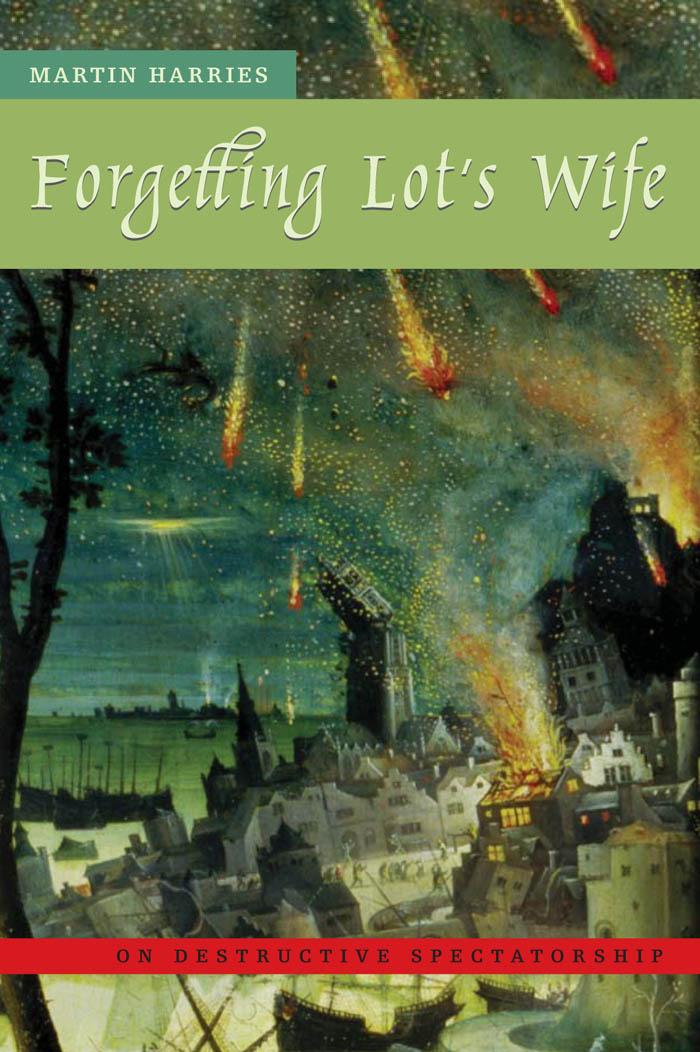
Can looking at disaster and mass death destroy us? Forgetting Lot’s Wife provides a theory and a fragmentary history of destructive spectatorship in the twentieth century. Its subject is the notion that the sight of historical catastrophe can destroy the spectator. The fragments of this history all lead back to the story of Lot’s wife: looking back at the destruction of the cities of Sodom and Gomorrah, she turns into a pillar of salt. This biblical story of punishment and transformation, a nexus of sexuality, sight, and cities, becomes the template for the modern fear that looking back at disaster might petrify the spectator. Although rarely articulated directly,
this idea remains powerful in our culture. This book traces some of its aesthetic, theoretical, and ethical consequences.
Harries traces the figure of Lot’s wife across media. In extended engagements with examples from twentieth-century theater, film, and painting, he focuses on the theatrical theory of Antonin Artaud, a series of American films, and paintings by Anselm Kiefer. These examples all return to the story of Lot’s wife as a way to think about modern predicaments of the spectator. On the one hand, the sometimes veiled figure of Lot’s wife allows these artists to picture the desire to destroy the spectator; on the other, she stands as a sign of the potential danger to the spectator. These works, that is, enact critiques of the very desire that inspires them.
The book closes with an extended meditation on September 11, criticizing the notion that we should have been destroyed by witnessing the events of that day.
Pay easily by card, Klarna, Apple Pay or Google Pay. Not happy? You always have a 14-day money-back guarantee. Read more in our terms. If you have any questions, email us at hello@memmo.org.
Memmo makes studying easier – wherever you are in the world. We bring your course books and smart study tools together in one place: summaries, quizzes, podcasts and flashcards. Plus Ted, your study buddy who answers anything you wonder. Over 50,000 students already study here – built to help you learn faster and stress less.