
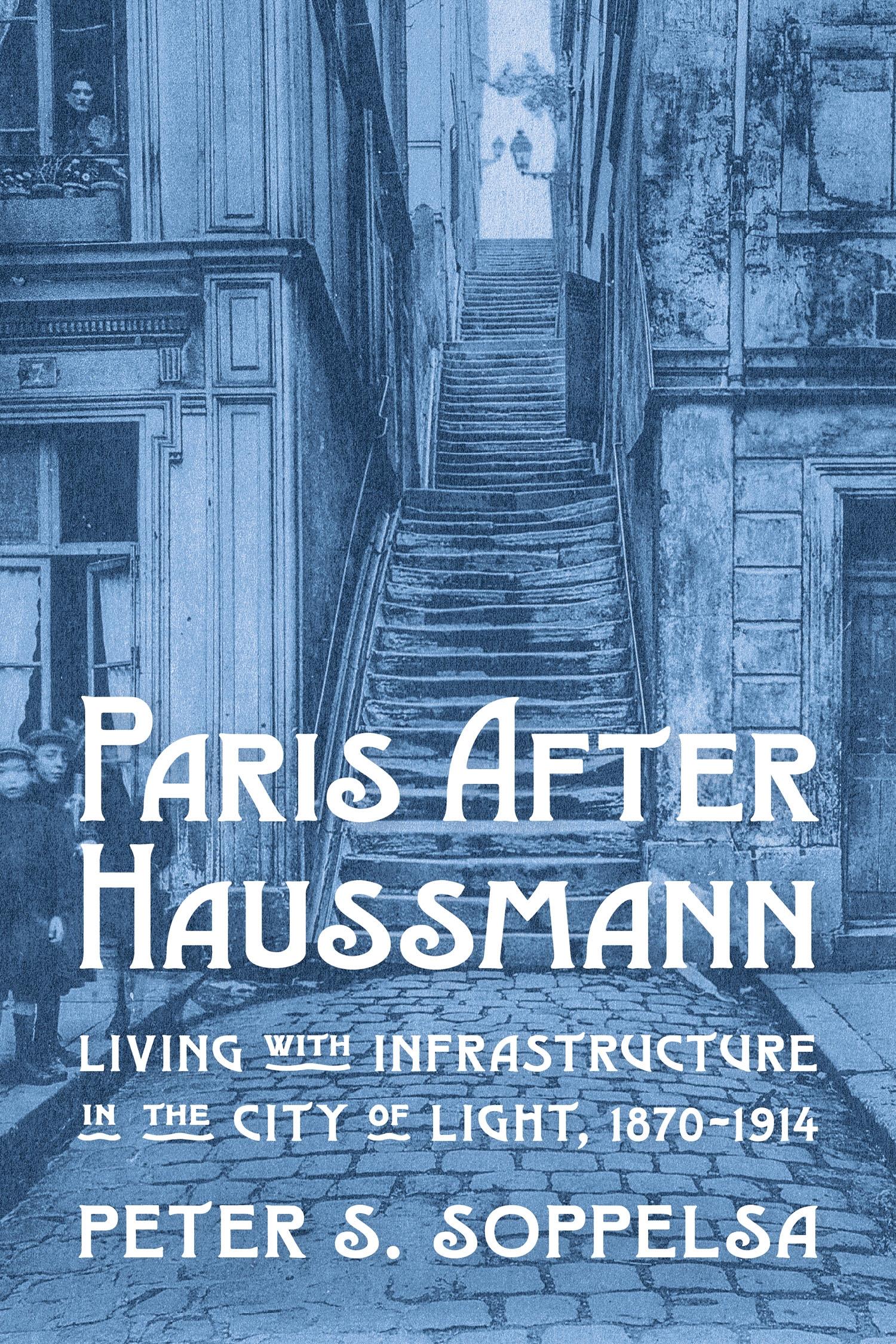
Modern Paris is often hailed as a capital of urban infrastructure. Baron Georges-Eugène Haussmann’s rebuilding of Paris in 1853–1870, branded “Haussmannization,” helped define urban modernity for cities worldwide. But even as infrastructures expanded and modernized, some Parisians were left behind: as late as 1928, 18 percent of houses still lacked direct sewerage. Haussmannization often hid infrastructures behind walls and floors, under streets, or in peripheral districts. In the forty years after 1870, a period that Peter Soppelsa calls “secondary Haussmannization,” Parisians inverted them—revealed their hidden components to scrutinize their workings and costs for society, environment, and health—and in turn politicized them. Drawing on French government archives, engineers’ maps, the illustrated press, and a collection of over 100 photographic postcards, Soppelsa charts the diverse embodied, emotional, and everyday experiences of living with expanding urban infrastructures—streets, housing, tramways, subways, the water supply, sewers, and rivers—in Paris from 1870 to 1914. Parisians learned that infrastructures were not simply technical solutions for the social and environmental problems of city life but could also bring about new dangers and dependencies.
Pay easily by card, Klarna, Apple Pay or Google Pay. Not happy? You always have a 14-day money-back guarantee. Read more in our terms. If you have any questions, email us at hello@memmo.org.
Memmo makes studying easier – wherever you are in the world. We bring your course books and smart study tools together in one place: summaries, quizzes, podcasts and flashcards. Plus Ted, your study buddy who answers anything you wonder. Over 75,000 students already study here – built to help you learn faster and stress less.
You might also like
Buy the book0