
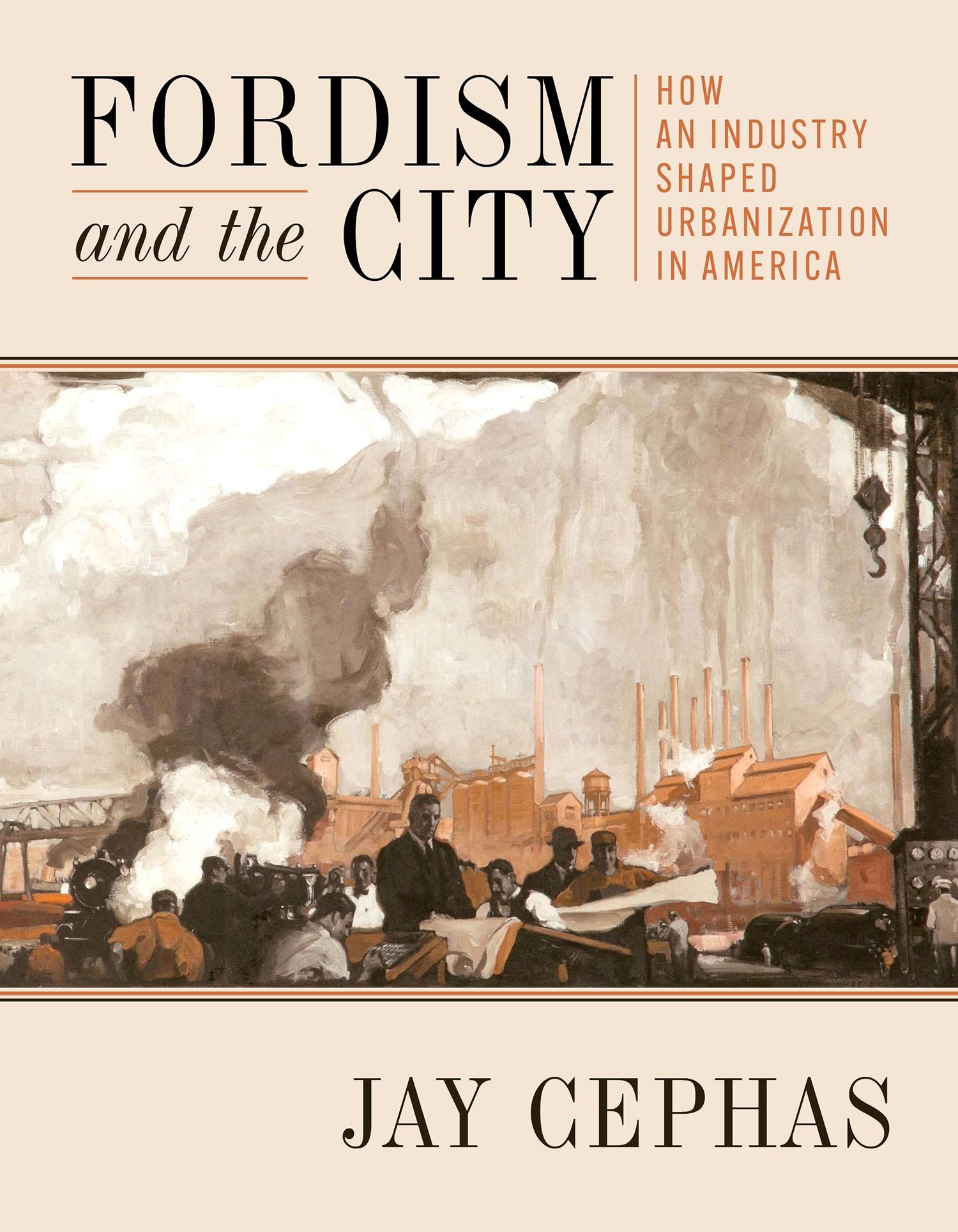
In the early twentieth century, the Ford Motor Company built an industrial empire with massive factory complexes and associated infrastructures. Henry Ford’s 1915 plan to decentralize industrial manufacturing relied on moving key technical processes closer to sites of resource extraction while distributing elements of production. In Fordism and the City, Jay Cephas analyzes key infrastructures—from factories and mills to roads, rail lines, and canals—to trace the impact of automated, assembly-line production on the urban and rural landscapes of Michigan. The overwhelming scale of the Ford Motor Company’s plant in Dearborn, the idyllic setting of its small village factories throughout the Rouge River corridor, and the remoteness of the company’s iron ore mines and hardwood forests in the Upper Peninsula all played an important role. Under the rubric of “the industrial city,” Fordism sought to replace conventional urbanism, reconfiguring factory production and then making its practices visible and intelligible to a consuming public through an industrial aesthetic. In doing so, Cephas shows, Fordism functioned as a normalizing force that helped to usher in the new industrial society.
Category: Arkitektur & Stadsplanering
e-ISBN: 9780822992301
Pay easily by card, Klarna, Apple Pay or Google Pay. Not happy? You always have a 14-day money-back guarantee. Read more in our terms. If you have any questions, email us at hello@memmo.org.
Memmo makes studying easier – wherever you are in the world. We bring your course books and smart study tools together in one place: summaries, quizzes, podcasts and flashcards. Plus Ted, your study buddy who answers anything you wonder. Over 50,000 students already study here – built to help you learn faster and stress less.
You might also like
Buy the book0