
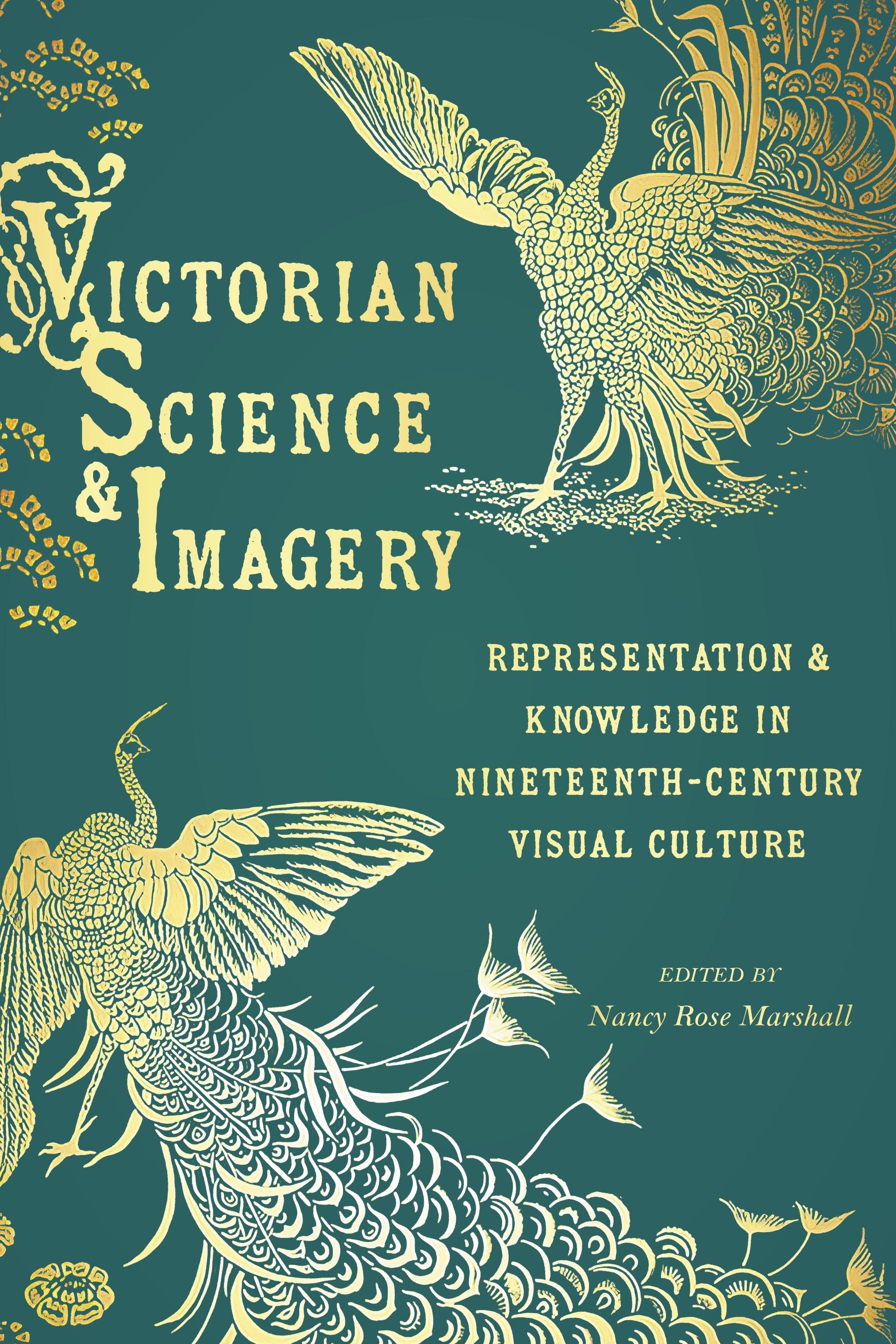
The nineteenth century was a period of science and imagery: when scientific theories and discoveries challenged longstanding boundaries between animal, plant, and human, and when art and visual culture produced new notions about the place of the human in the natural world. Just as scientists relied on graphic representation to conceptualize their ideas, artists moved seamlessly between scientific debate and creative expression to support or contradict popular scientific theories—such as Darwin’s theory of evolution and sexual selection—deliberately drawing on concepts in ways that allowed them to refute popular claims or disrupt conventional knowledges.
Focusing on the close kinship between the arts and sciences during the Victorian period, the art historians contributing to this volume reveal the unique ways in which nineteenth-century British and American visual culture participated in making science, and in which science informed art at a crucial moment in the history of the development of the modern world. Together, they explore topics in geology, meteorology, medicine, anatomy, evolution, and zoology, as well as a range of media from photography to oil painting. They remind us that science and art are not tightly compartmentalized, separate influences. Rather, these are fields that share forms, manifest as waves, layers, lines, or geometries; that invest in the idea of the evolution of form; and that generate surprisingly kindred responses, such as pain, pleasure, empathy, and sympathy.
Focusing on the close kinship between the arts and sciences during the Victorian period, the art historians contributing to this volume reveal the unique ways in which nineteenth-century British and American visual culture participated in making science, and in which science informed art at a crucial moment in the history of the development of the modern world. Together, they explore topics in geology, meteorology, medicine, anatomy, evolution, and zoology, as well as a range of media from photography to oil painting. They remind us that science and art are not tightly compartmentalized, separate influences. Rather, these are fields that share forms, manifest as waves, layers, lines, or geometries; that invest in the idea of the evolution of form; and that generate surprisingly kindred responses, such as pain, pleasure, empathy, and sympathy.
Pay easily by card, Klarna, Apple Pay or Google Pay. Not happy? You always have a 14-day money-back guarantee. Read more in our terms. If you have any questions, email us at hello@memmo.org.
Memmo makes studying easier – wherever you are in the world. We bring your course books and smart study tools together in one place: summaries, quizzes, podcasts and flashcards. Plus Ted, your study buddy who answers anything you wonder. Over 50,000 students already study here – built to help you learn faster and stress less.
You might also like
Buy the book0