
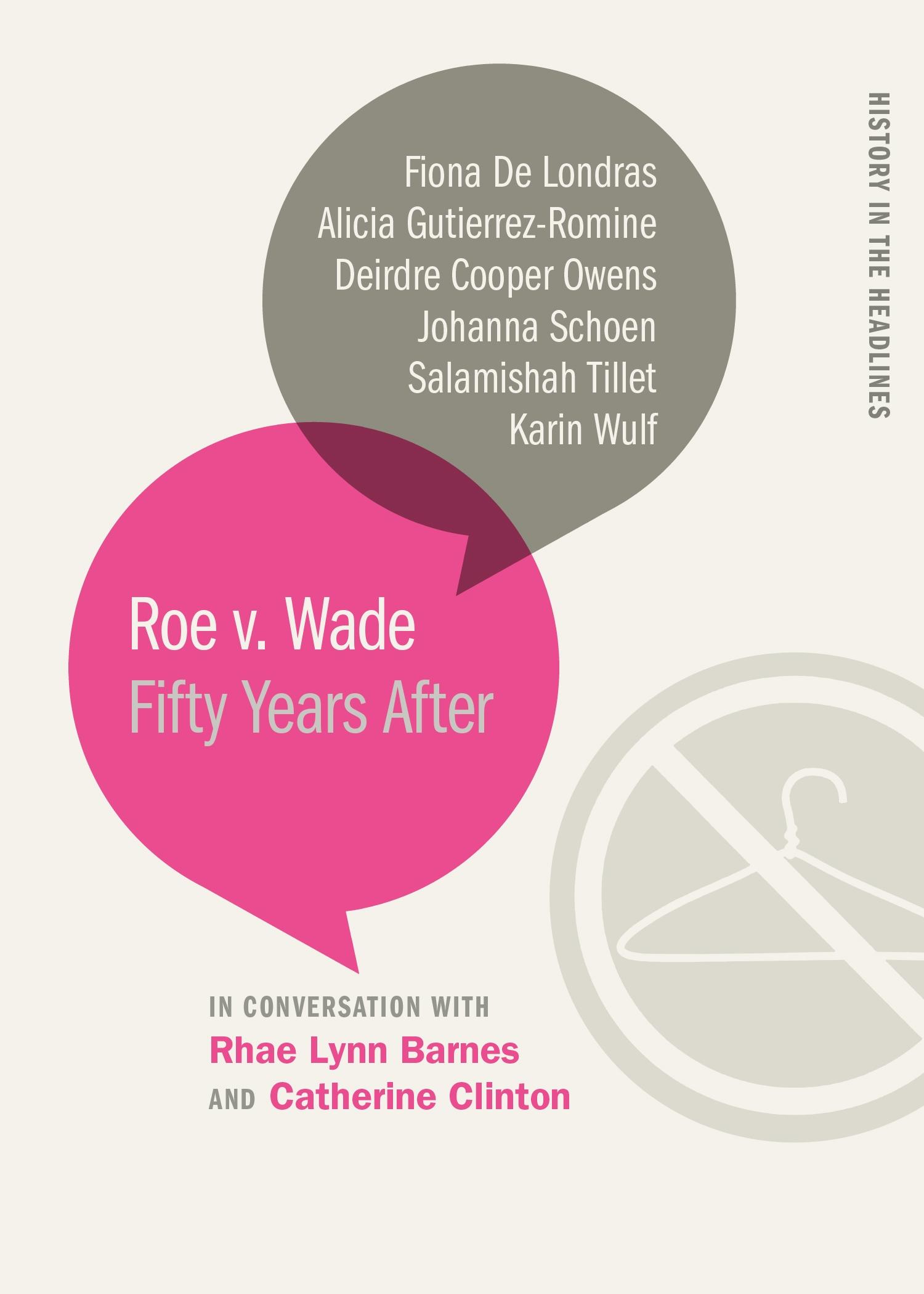
Just over fifty years ago on January 22, 1973, the United States Supreme Court decision on Roe v. Wade assured millions of women that abortion was a protected constitutional right due to a woman’s right to privacy. In the context of the burgeoning women’s rights movement, it seemed like an inalienable victory: women might become equal to men in their right to determine what would happen to their bodies. This was a hard-won fight that reached back to colonial America and slavery, but on June 24, 2022, the decision was shockingly reversed by the Supreme Court in Dobbs v. Jackson Women’s Health Organization. What happened? What transpired socially, politically, legally, in religious institutions and in popular culture in the half-century when “the right to choose” led to this stunning transformation in American society?
Roe v. Wade: Fifty Years After, coedited by Rhae Lynn Barnes and Catherine Clinton for the History in the Headlines series, brings together a team of world-renowned scholars, prizewinning historians, and Pulitzer Prize-winning public intellectuals who specialize in reproductive history. They assembled at Harvard University in the weeks following the Dobbs decision to talk through the centuries-long history of abortion in what became the United States, how its representation changed in the law and popular culture, and how a wellspring of social movements on both the right and left led to a fifty-year showdown over some of the most outstanding human questions: What is life? When does it begin? Who has the right to end it? Who has the right to determine what happens to someone else’s body? How can the law define and restrict women’s reproductive health? And how have race, class, geography, sexuality, and other factors shaped who gets to be a part of answering these questions? The international impact of the struggles for reproductive freedom for women within the United States comes into sharp focus within this important volume, shedding light on past, present, and future dimensions of reproductive freedom for all Americans.
Pay easily by card, Klarna, Apple Pay or Google Pay. Not happy? You always have a 14-day money-back guarantee. Read more in our terms. If you have any questions, email us at hello@memmo.org.
Memmo makes studying easier – wherever you are in the world. We bring your course books and smart study tools together in one place: summaries, quizzes, podcasts and flashcards. Plus Ted, your study buddy who answers anything you wonder. Over 50,000 students already study here – built to help you learn faster and stress less.