
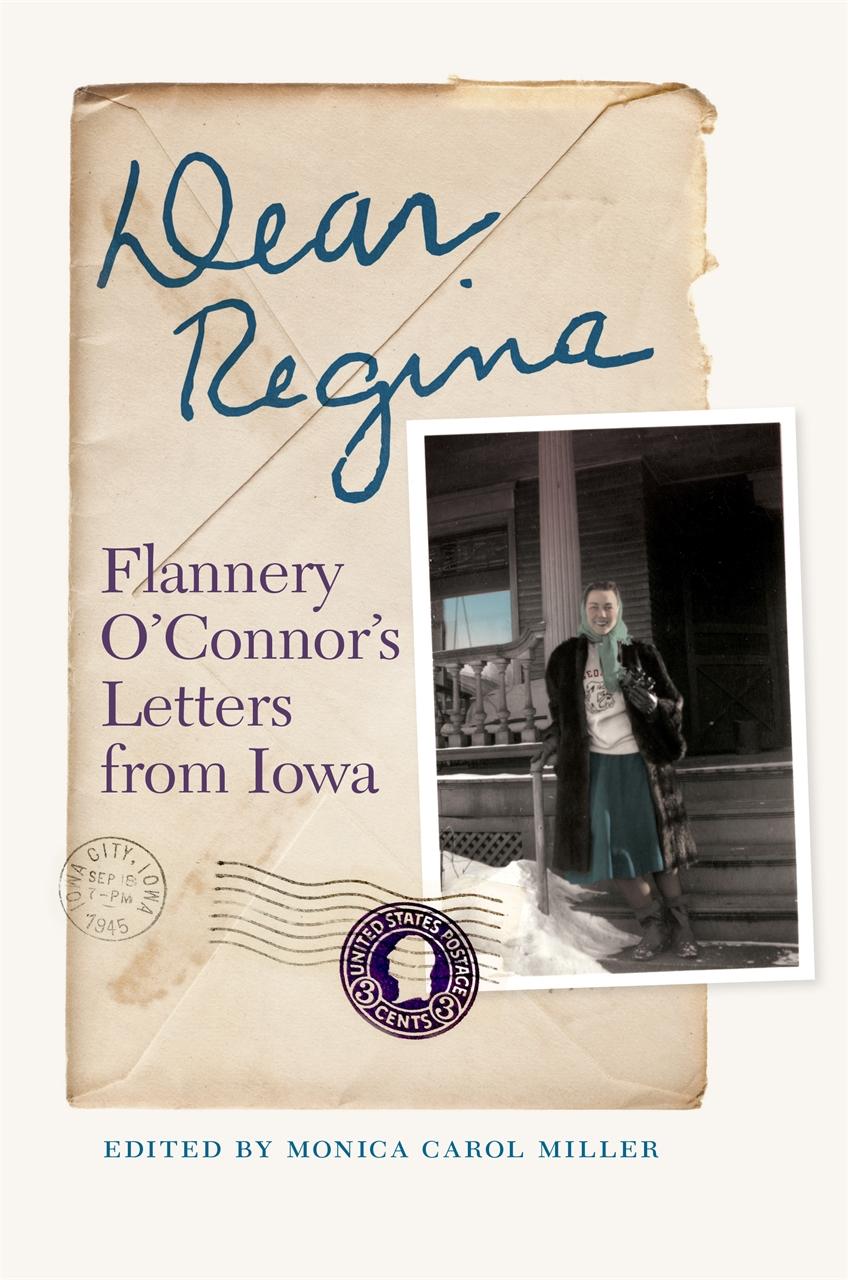
Dear Regina offers a remarkable window into the early years of one of America’s best-known literary figures. While at the University of Iowa Writer’s Workshop from 1945 to 1948, Flannery O’Connor wrote to her mother Regina Cline O’Connor (who she addressed by her first name) nearly every day and sometimes more than once a day. The complete correspondence of more than six hundred letters is housed at the Stuart A. Rose Manuscript, Archives, and Rare Book Library at Emory University. From that number, Miller selects 486 letters to show us a young adult learning to adjust to life on her own for the first time. In these letters, O’Connor shares details about living in a boardinghouse and subsisting on canned food and hot-plate dinners, and she asks for advice about a wide range of topics, including how to assuage her relatives’ concerns about her well-being and how to buy whiskey to use for cough medicine.
These letters, which are being published for the first time with the unprecedented permission of the Mary Flannery O’Connor Charitable Trust, also off er readers important insights into O’Connor’s intellectually formative years, when her ideas about writing, race, class, and interpersonal relationships were developing and changing. Her preoccupation with money, employment, and other practical matters reveals a side of O’Connor that we do not often see in her previously published letters. Most importantly, the letters show us her relationship with her mother in a much more intimate, positive light than we have seen before. The importance of this aspect of the letters cannot be overstated, given that so much literary analysis conflates her and Regina with the “sour, deformed daughters and self-righteous mothers” that critic Louise Westling sees so often in O’Connor’s work.
Pay easily by card, Klarna, Apple Pay or Google Pay. Not happy? You always have a 14-day money-back guarantee. Read more in our terms. If you have any questions, email us at hello@memmo.org.
Memmo makes studying easier – wherever you are in the world. We bring your course books and smart study tools together in one place: summaries, quizzes, podcasts and flashcards. Plus Ted, your study buddy who answers anything you wonder. Over 50,000 students already study here – built to help you learn faster and stress less.