
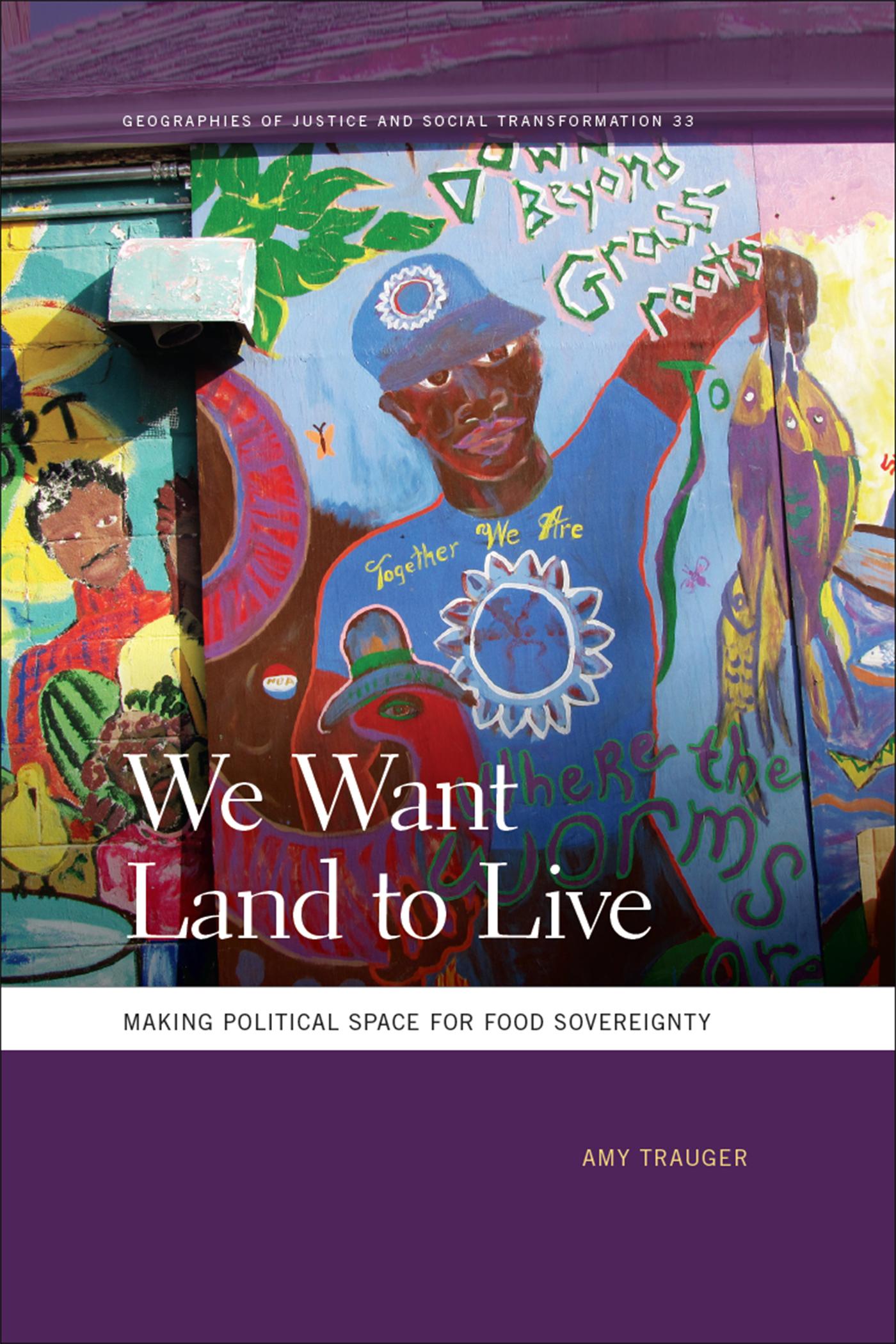
We Want Land to Live explores the current boundaries of radical approaches to food sovereignty. First coined by La Via Campesina (a global movement whose name means “the peasant’s way”), food sovereignty is a concept that expresses the universal right to food. Amy Trauger uses research combining ethnography, participant observation, field notes, and interviews to help us understand the material and definitional struggles surrounding the decommodification of food and the transformation of the global food system’s political-economic foundations.
Trauger’s work is the first of its kind to analytically and coherently link a dialogue on food sovereignty with case studies illustrating the spatial and territorial strategies by which the movement fosters its life in the margins of the corporate food regime. She discusses community gardeners in Portugal; small-scale, independent farmers in Maine; Native American wild rice gatherers in Minnesota; seed library supporters in Pennsylvania; and permaculturists in Georgia.
The problem in the food system, as the activists profiled here see it, is not markets or the role of governance but that the right to food is conditioned by what the state and corporations deem to be safe, legal, and profitable—and not by what eaters think is right in terms of their health, the environment, or their communities. Useful for classes on food studies and active food movements alike, We Want Land to Live makes food sovereignty issues real as it illustrates a range of methodological alternatives that are consistent with its discourse: direct action (rather than charity, market creation, or policy changes), civil disobedience (rather than compliance with discriminatory laws), and mutual aid (rather than reliance on top-down aid).
Pay easily by card, Klarna, Apple Pay or Google Pay. Not happy? You always have a 14-day money-back guarantee. Read more in our terms. If you have any questions, email us at hello@memmo.org.
Memmo makes studying easier – wherever you are in the world. We bring your course books and smart study tools together in one place: summaries, quizzes, podcasts and flashcards. Plus Ted, your study buddy who answers anything you wonder. Over 50,000 students already study here – built to help you learn faster and stress less.