
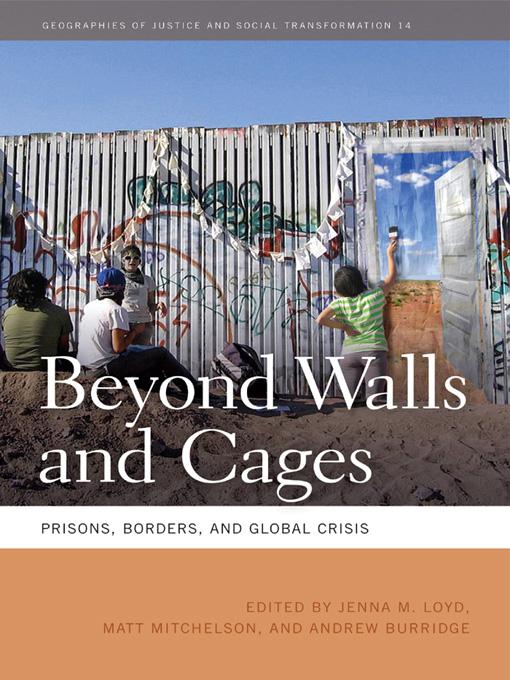
Beyond Walls and Cages
Author: Harsha Walia, Luis A. Fernandez, Joseph Nevins, Ruth Wilson Gilmore, Maria Cristina Morales, Jenna M. Loyd, Alison Mountz, Anne Bonds, Bob Libal, Christopher Stenken, Cynthia Bejarano, Jodie M. Lawston, Joshua M. Price, Laura McTighe, Lauren Martin, Margo Tamez, Mariana Viturro, Micol Seigel, Monica W. Varsanyi, Nicole D. Porter, Olga Aksyutina, Proma Tagore, Rashad Shabazz, Renee Feltz, Ruben R. Murillo, Said Saddiki, Stokely Baksh, Subhash Kateel, Zoe Hammer-Tomizuka, Matt Mitchelson, Andrew Burridge, Borderlands Autonomist Collective, Amy Gottlieb, Gael Guevara, Julianne Hing, Elizabeth Vargas, Seth Freed Wessler
Publisher: University of Georgia Press
Published date: 2012
ISBN: 9780820344126
The crisis of borders and prisons can be seen starkly in statistics. In 2011 some 1,500 migrants died trying to enter Europe, and the United States deported nearly 400,000 and imprisoned some 2.3 million people—more than at any other time in history. International borders are increasingly militarized places embedded within domestic policing and imprisonment and entwined with expanding prison-industrial complexes. Beyond Walls and Cages offers scholarly and activist perspectives on these issues and explores how the international community can move toward a more humane future.Working at a range of geographic scales and locations, contributors examine concrete and ideological connections among prisons, migration policing and detention, border fortification, and militarization. They challenge the idea that prisons and borders create safety, security, and order, showing that they can be forms of coercive mobility that separate loved ones, disempower communities, and increase shared harms of poverty. Walls and cages can also fortify wealth and power inequalities, racism, and gender and sexual oppression.As governments increasingly rely on criminalization and violent measures of exclusion and containment, strategies for achieving change are essential. Beyond Walls and Cages develops abolitionist, no borders, and decolonial analyses and methods for social change, showing how seemingly disconnected forms of state violence are interconnected. Creating a more just and free world—whether in the Mexico-U.S. borderlands, the Morocco-Spain region, South Africa, Montana, or Philadelphia—requires that people who are most affected become central to building alternatives to global crosscurrents of criminalization and militarization.
Pay easily by card, Klarna, Apple Pay or Google Pay. Not happy? You always have a 14-day money-back guarantee. Read more in our terms. If you have any questions, email us at hello@memmo.org.
Memmo makes studying easier – wherever you are in the world. We bring your course books and smart study tools together in one place: summaries, quizzes, podcasts and flashcards. Plus Ted, your study buddy who answers anything you wonder. Over 50,000 students already study here – built to help you learn faster and stress less.
You might also like
Buy the book0