
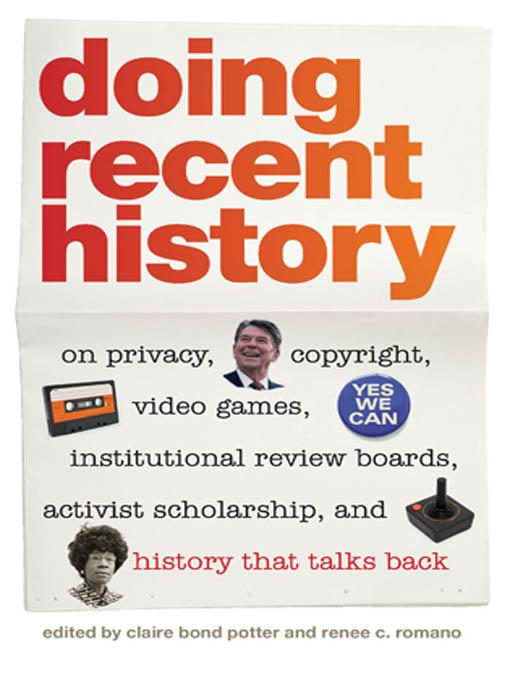
Doing Recent History
Recent history—the very phrase seems like an oxymoron. Yet historians have been writing accounts of the recent past since printed history acquired a modern audience, and in the last several years interest in recent topics has grown exponentially. With subjects as diverse as Walmart and disco, and personalities as disparate as Chavez and Schlafly, books about the history of our own time have become arguably the most exciting and talked-about part of the discipline.
Despite this rich tradition and growing popularity, historians have engaged in little discussion about the specific methodological, political, and ethical issues related to writing about the recent past. The twelve essays in this collection explore the challenges of writing histories of recent events where visibility is inherently imperfect, hindsight and perspective are lacking, and historiography is underdeveloped.
Those who write about events that have taken place since 1970 encounter exciting challenges that are both familiar and foreign to scholars of a more distant past, including suspicions that their research is not historical enough, negotiation with living witnesses who have a very strong stake in their own representation, and the task of working with new electronic sources. Contributors to this collection consider a wide range of these challenges. They question how sources like television and video games can be better utilized in historical research, explore the role and regulation of doing oral histories, consider the ethics of writing about living subjects, discuss how historians can best navigate questions of privacy and copyright law, and imagine the possibilities that new technologies offer for creating transnational and translingual research opportunities. Doing Recent History offers guidance and insight to any researcher considering tackling the not-so-distant past.
Pay easily by card, Klarna, Apple Pay or Google Pay. Not happy? You always have a 14-day money-back guarantee. Read more in our terms. If you have any questions, email us at hello@memmo.org.
Memmo makes studying easier – wherever you are in the world. We bring your course books and smart study tools together in one place: summaries, quizzes, podcasts and flashcards. Plus Ted, your study buddy who answers anything you wonder. Over 50,000 students already study here – built to help you learn faster and stress less.