
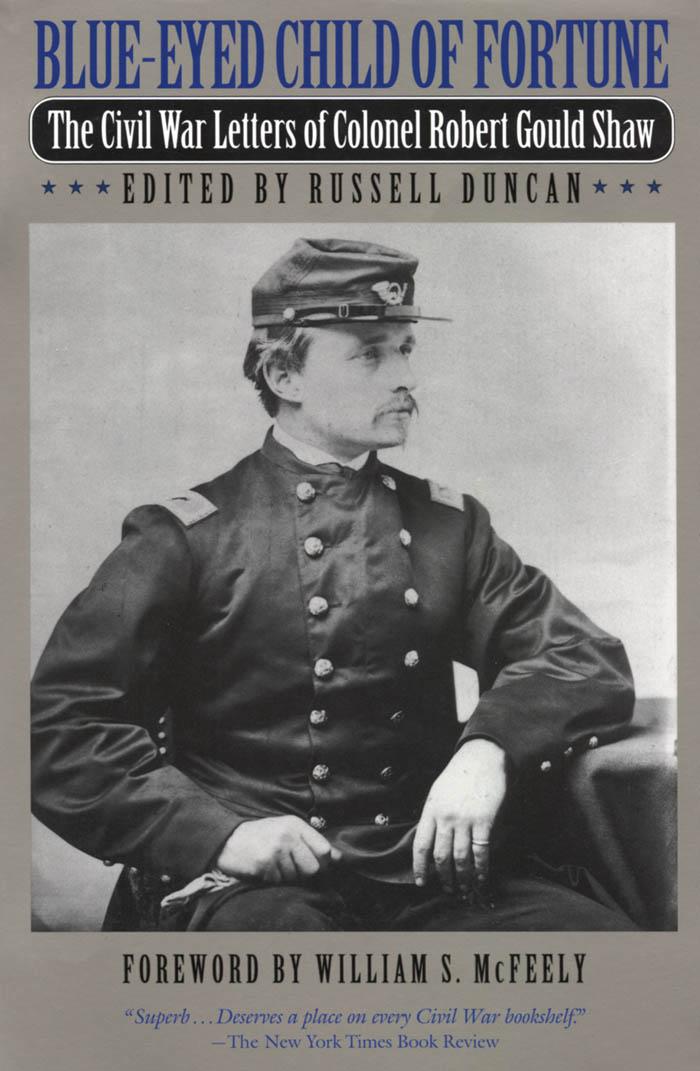
On the Boston Common stands one of the great Civil War memorials, a magnificent bronze sculpture by Augustus Saint-Gaudens. It depicts the black soldiers of the Fifty-fourth Massachusetts Infantry marching alongside their young white commander, Colonel Robert Gould Shaw. When the philosopher William James dedicated the memorial in May 1897, he stirred the assembled crowd with these words: "There they march, warm-blooded champions of a better day for man. There on horseback among them, in the very habit as he lived, sits the blue-eyed child of fortune."
In this book Shaw speaks for himself with equal eloquence through nearly two hundred letters he wrote to his family and friends during the Civil War. The portrait that emerges is of a man more divided and complex—though no less heroic—than the Shaw depicted in the celebrated film Glory. The pampered son of wealthy Boston abolitionists, Shaw was no abolitionist himself, but he was among the first patriots to respond to Lincoln's call for troops after the attack on Fort Sumter. After Cedar Mountain and Antietam, Shaw knew the carnage of war firsthand. Describing nightfall on the Antietam battlefield, he wrote, "the crickets chirped, and the frogs croaked, just as if nothing unusual had happened all day long, and presently the stars came out bright, and we lay down among the dead, and slept soundly until daylight. There were twenty dead bodies within a rod of me."
When Federal war aims shifted from an emphasis on restoring the Union to the higher goal of emancipation for four million slaves, Shaw's mother pressured her son into accepting the command of the North's vanguard black regiment, the Fifty-fourth Massachusetts. A paternalist who never fully reconciled his own prejudices about black inferiority, Shaw assumed the command with great reluctance. Yet, as he trained his recruits in Readville, Massachusetts, during the early months of 1963, he came to respect their pluck and dedication. "There is not the least doubt," he wrote his mother, "that we shall leave the state, with as good a regiment, as any that has marched."
Despite such expressions of confidence, Shaw in fact continued to worry about how well his troops would perform under fire. The ultimate test came in South Carolina in July 1863, when the Fifty-fourth led a brave but ill-fated charge on Fort Wagner, at the approach to Charleston Harbor. As Shaw waved his sword and urged his men forward, an enemy bullet felled him on the fort's parapet. A few hours later the Confederates dumped his body into a mass grave with the bodies of twenty of his men. Although the assault was a failure from a military standpoint, it proved the proposition to which Shaw had reluctantly dedicated himself when he took command of the Fifty-fourth: that black soldiers could indeed be fighting men. By year's end, sixty new black regiments were being organized.
A previous selection of Shaw's correspondence was privately published by his family in 1864. For this volume, Russell Duncan has restored many passages omitted from the earlier edition and has provided detailed explanatory notes to the letters. In addition he has written a lengthy biographical essay that places the young colonel and his regiment in historical context.
Pay easily by card, Klarna, Apple Pay or Google Pay. Not happy? You always have a 14-day money-back guarantee. Read more in our terms. If you have any questions, email us at hello@memmo.org.
Memmo makes studying easier – wherever you are in the world. We bring your course books and smart study tools together in one place: summaries, quizzes, podcasts and flashcards. Plus Ted, your study buddy who answers anything you wonder. Over 50,000 students already study here – built to help you learn faster and stress less.