
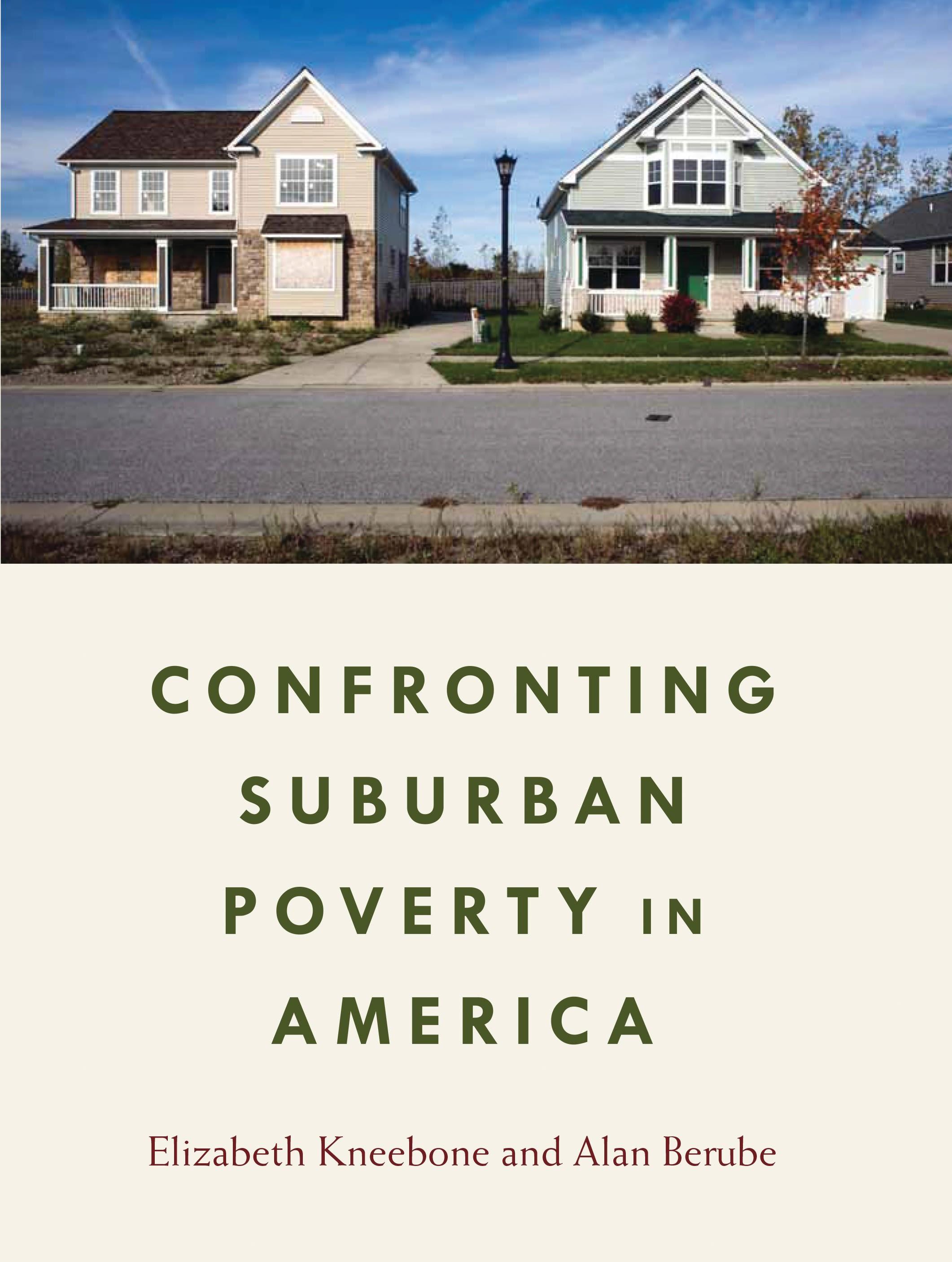
It has been nearly a half century since President Lyndon Johnson declared war on poverty. Back in the 1960s tackling poverty ""in place"" meant focusing resources in the inner city and in rural areas. The suburbs were seen as home to middle- and upper-class families-affluent commuters and homeowners looking for good schools and safe communities in which to raise their kids. But today's America is a very different place. Poverty is no longer just an urban or rural problem, but increasingly a suburban one as well. In Confronting Suburban Poverty in America, Elizabeth Kneebone and Alan Berube take on the new reality of metropolitan poverty and opportunity in America.
After decades in which suburbs added poor residents at a faster pace than cities, the 2000s marked a tipping point. Suburbia is now home to the largest and fastest-growing poor population in the country and more than half of the metropolitan poor. However, the antipoverty infrastructure built over the past several decades does not fit this rapidly changing geography. As Kneebone and Berube cogently demonstrate, the solution no longer fits the problem.
The spread of suburban poverty has many causes, including shifts in affordable housing and jobs, population dynamics, immigration, and a struggling economy. The phenomenon raises several daunting challenges, such as the need for more (and better) transportation options, services, and financial resources. But necessity also produces opportunity-in this case, the opportunity to rethink and modernize services, structures, and procedures so that they work in more scaled, cross-cutting, and resource-efficient ways to address widespread need. This book embraces that opportunity.
Kneebone and Berube paint a new picture of poverty in America as well as the best ways to combat it. Confronting Suburban Poverty in America offers a series of workable recommendations for public, private, and nonprofit leaders seeking to modernize po
After decades in which suburbs added poor residents at a faster pace than cities, the 2000s marked a tipping point. Suburbia is now home to the largest and fastest-growing poor population in the country and more than half of the metropolitan poor. However, the antipoverty infrastructure built over the past several decades does not fit this rapidly changing geography. As Kneebone and Berube cogently demonstrate, the solution no longer fits the problem.
The spread of suburban poverty has many causes, including shifts in affordable housing and jobs, population dynamics, immigration, and a struggling economy. The phenomenon raises several daunting challenges, such as the need for more (and better) transportation options, services, and financial resources. But necessity also produces opportunity-in this case, the opportunity to rethink and modernize services, structures, and procedures so that they work in more scaled, cross-cutting, and resource-efficient ways to address widespread need. This book embraces that opportunity.
Kneebone and Berube paint a new picture of poverty in America as well as the best ways to combat it. Confronting Suburban Poverty in America offers a series of workable recommendations for public, private, and nonprofit leaders seeking to modernize po
Pay easily by card, Klarna, Apple Pay or Google Pay. Not happy? You always have a 14-day money-back guarantee. Read more in our terms. If you have any questions, email us at hello@memmo.org.
Memmo makes studying easier – wherever you are in the world. We bring your course books and smart study tools together in one place: summaries, quizzes, podcasts and flashcards. Plus Ted, your study buddy who answers anything you wonder. Over 50,000 students already study here – built to help you learn faster and stress less.