
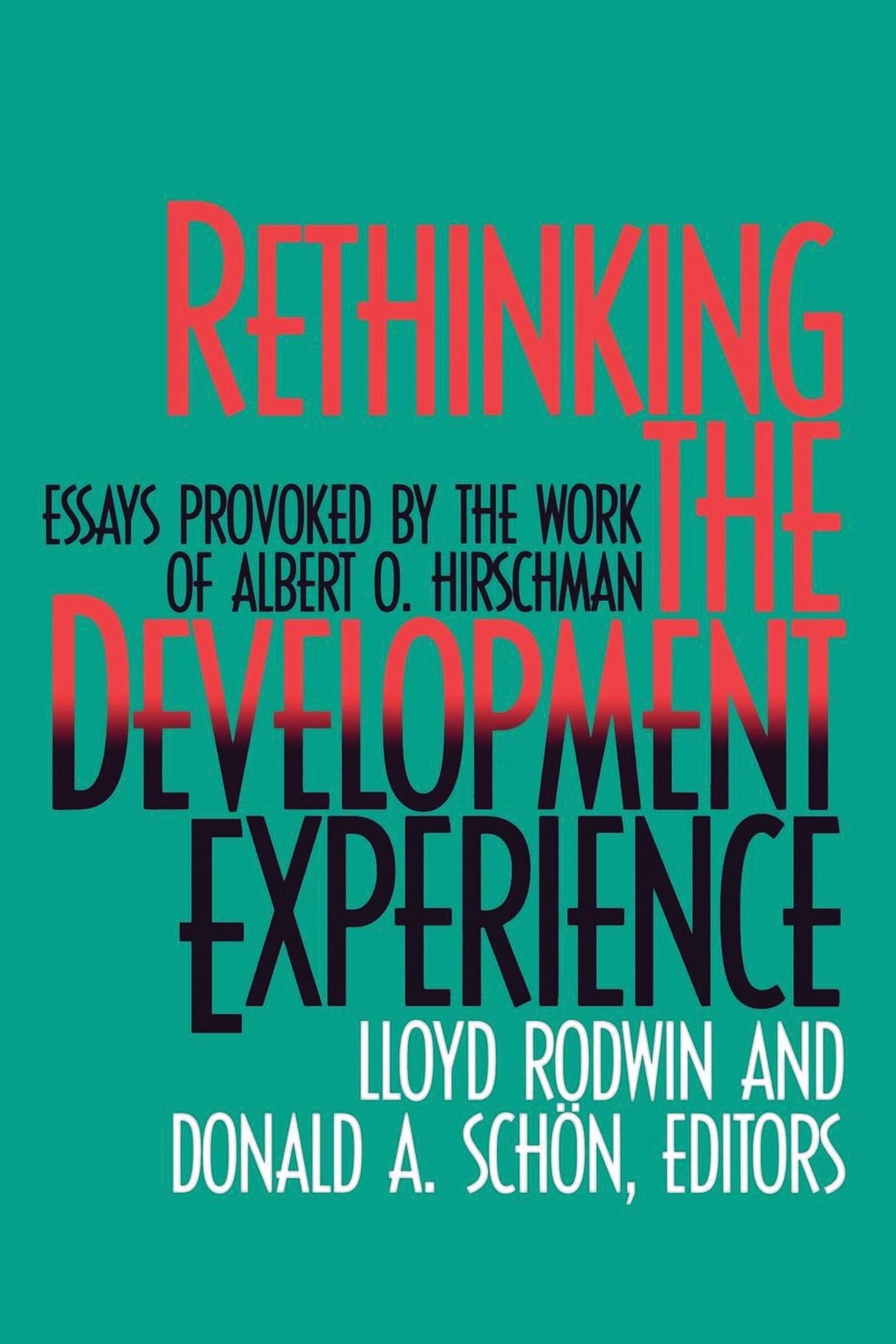
This book, written by a group of distinguished scholars and practitioners, critically reappraises ideas about learning and development advanced by Albert O. Hirschman in the 1950s and 1960s. The essays-prepared for an MIT faculty seminar-show how these innovative ideas bear on the theory, policy, and practice of development in the 1990s. Hirschman, one of the great pioneers in the field of economic development, is now professor emeritus at Princeton.
Paul Krugman, Lance Taylor, and Donald Schön address the different approaches and assumptions of economic theorists in relation to modelling, learning, and development policy. Emma Rothschild, Lisa Peattie, and Bishwapryiya Sanyal examine some of the changing attitudes toward economic progress. Elliot Marseille, Judith Tendler, Sara Friedheim, Robert Picciotto, and Charles Sabel draw lessons from efforts to innovate or modify institutions, policies, programs, and projects. Lloyd Rodwin examines the underlying themes that emerge, particularly those that touch on the ideas of development as a process of social learning and on ways of strengthening theory, policy, and practice in economics when it is seen as both discipline and profession.
In a postscript, Albert O. Hirschman reflects on the evolution of his ideas, his cognitive style, and his propensity for self-subversion. Two appendixes detail the candid seminar discussions and Hirschman's musings in response to particular chapters and questions raised by the participants.
Paul Krugman, Lance Taylor, and Donald Schön address the different approaches and assumptions of economic theorists in relation to modelling, learning, and development policy. Emma Rothschild, Lisa Peattie, and Bishwapryiya Sanyal examine some of the changing attitudes toward economic progress. Elliot Marseille, Judith Tendler, Sara Friedheim, Robert Picciotto, and Charles Sabel draw lessons from efforts to innovate or modify institutions, policies, programs, and projects. Lloyd Rodwin examines the underlying themes that emerge, particularly those that touch on the ideas of development as a process of social learning and on ways of strengthening theory, policy, and practice in economics when it is seen as both discipline and profession.
In a postscript, Albert O. Hirschman reflects on the evolution of his ideas, his cognitive style, and his propensity for self-subversion. Two appendixes detail the candid seminar discussions and Hirschman's musings in response to particular chapters and questions raised by the participants.
Pages: 386
Category: Ekonomi & Utveckling
e-ISBN: 9780815720591
Shipping weight: 1.2 kg
Ships in: 1-2 days
Pay easily by card, Klarna, Apple Pay or Google Pay. Not happy? You always have a 14-day money-back guarantee. Read more in our terms. If you have any questions, email us at hello@memmo.org.
Memmo makes studying easier – wherever you are in the world. We bring your course books and smart study tools together in one place: summaries, quizzes, podcasts and flashcards. Plus Ted, your study buddy who answers anything you wonder. Over 50,000 students already study here – built to help you learn faster and stress less.