
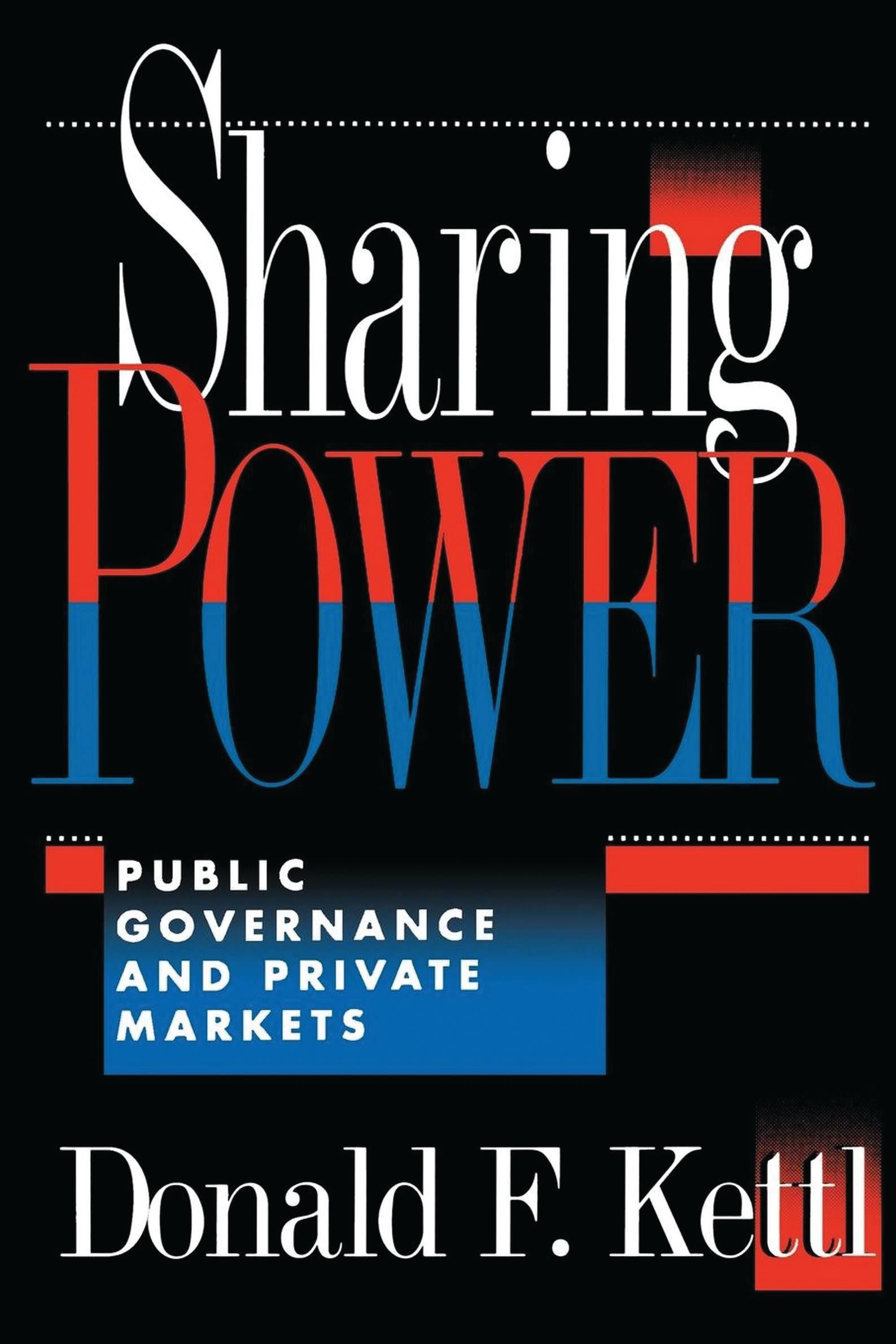
In the flush of enthusiasm to make government work better, reformers from both left and right have urged government to turn as many functions as possible over to the private sector and to allow market competition instill efficiency and choice. In fact, government has been doing just this for years: every major policy initiative launched since World War II has been managed by public-private partnerships. Yet such privatization has not solved government's problems. While there have been some positive results, thee has been far less success than advocates of market competition have promised.
In a searching examination of why the ""competition prescription"" has not worked well, Donald F. Kettl finds that government has largely been a poor judge of private markets. Because government rarely operates in truly competitive markets contracting out has not so much solved the problems of inefficiency, but has aggravated them. Government has often not proved to be an intelligent consumer of the goods and services it has purchased. Kettl provides specific recommendations as to how government can become a ""smart buyer,"" knowing what it wants and judging better what it has bought.
Through detailed case studies, Kettl shows that as market imperfections increase, so do problems in governance and management. He examines the A-76 program for buying goods and services, the FTS-2000 telecommunications system, the Superfund program, the Department of Energy's production of nuclear weapons, and contracting out by state and local governments. He argues that government must be more aggressive in managing contracts if it is to build successful partnerships with outside contractors.
Kettl maintains that the answer is not more government, but a smarter one, which requires strong political leadership to refocus the bureaucracy's mission and to change the bureaucratic culture.
In a searching examination of why the ""competition prescription"" has not worked well, Donald F. Kettl finds that government has largely been a poor judge of private markets. Because government rarely operates in truly competitive markets contracting out has not so much solved the problems of inefficiency, but has aggravated them. Government has often not proved to be an intelligent consumer of the goods and services it has purchased. Kettl provides specific recommendations as to how government can become a ""smart buyer,"" knowing what it wants and judging better what it has bought.
Through detailed case studies, Kettl shows that as market imperfections increase, so do problems in governance and management. He examines the A-76 program for buying goods and services, the FTS-2000 telecommunications system, the Superfund program, the Department of Energy's production of nuclear weapons, and contracting out by state and local governments. He argues that government must be more aggressive in managing contracts if it is to build successful partnerships with outside contractors.
Kettl maintains that the answer is not more government, but a smarter one, which requires strong political leadership to refocus the bureaucracy's mission and to change the bureaucratic culture.
Pages: 234
Category: Statsvetenskap & Politik
e-ISBN: 9780815720065
Shipping weight: 1.2 kg
Ships in: 1-2 days
Pay easily by card, Klarna, Apple Pay or Google Pay. Not happy? You always have a 14-day money-back guarantee. Read more in our terms. If you have any questions, email us at hello@memmo.org.
Memmo makes studying easier – wherever you are in the world. We bring your course books and smart study tools together in one place: summaries, quizzes, podcasts and flashcards. Plus Ted, your study buddy who answers anything you wonder. Over 50,000 students already study here – built to help you learn faster and stress less.