
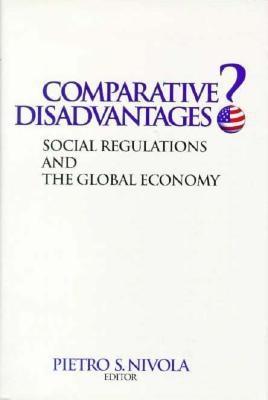
The American economy is in many ways uniquely unfettered. Nowhere else in the industrial world is it easier to set up a discount store, start a new airline, or shrink a payroll. But extensive economic deregulation has been matched by a burgeoning body of social law cracking down on business. From shareholder litigation and strict product liability to punitive environmental controls and workplace rules, entrepreneurs run a gauntlet of legal perils. The costs of this expanding and contentious agenda often exceed the value of its social benefits. The projected annual costs over benefits of the 1990 Clean Air Act, for instance, surpass the estimated value of U.S. exports blocked by all of Japan's known import restrictions. How sustainable is this situation amid the pressures of globalization? The contributors to this volume explore the question from a variety of perspectives.
U.S. policymakers frequently criticize the rest of the world for policies and practices that are said to constrict American commerce. Yet some trade disputes have been ignited by questionable rules made in the United States. Indeed, legal strictures have posed barriers to imports and possibly discouraged foreign investors, as well as interfered with some U.S. exports. At times the social regulatory regime has also stirred abrasive efforts to extend U.S. sanctions to foreign soil. Even if those frictions have been of minor consequences so far, inefficient legal and regulatory conventions exact a toll on U.S. productivity growth.
The book concludes that in a global economy the burdensome regulations of foreign countries deserve attention, but increasingly so do the burdens that American ""adversarial legalism"" imposes on itself and sometimes on others. Ideas and prospects for correcting the problem are discussed throughout.
The contributors include Lee Axelrad, Thomas F. Burke, Loren Cass, Robert A. Kagan, Mark K. Landy, Roger G. Noll, and David Vogel.
U.S. policymakers frequently criticize the rest of the world for policies and practices that are said to constrict American commerce. Yet some trade disputes have been ignited by questionable rules made in the United States. Indeed, legal strictures have posed barriers to imports and possibly discouraged foreign investors, as well as interfered with some U.S. exports. At times the social regulatory regime has also stirred abrasive efforts to extend U.S. sanctions to foreign soil. Even if those frictions have been of minor consequences so far, inefficient legal and regulatory conventions exact a toll on U.S. productivity growth.
The book concludes that in a global economy the burdensome regulations of foreign countries deserve attention, but increasingly so do the burdens that American ""adversarial legalism"" imposes on itself and sometimes on others. Ideas and prospects for correcting the problem are discussed throughout.
The contributors include Lee Axelrad, Thomas F. Burke, Loren Cass, Robert A. Kagan, Mark K. Landy, Roger G. Noll, and David Vogel.
Pages: 368
Category: Ekonomi & Utveckling
e-ISBN: 9780815708070
Shipping weight: 1.2 kg
Ships in: 1-2 days
Pay easily by card, Klarna, Apple Pay or Google Pay. Not happy? You always have a 14-day money-back guarantee. Read more in our terms. If you have any questions, email us at hello@memmo.org.
Memmo makes studying easier – wherever you are in the world. We bring your course books and smart study tools together in one place: summaries, quizzes, podcasts and flashcards. Plus Ted, your study buddy who answers anything you wonder. Over 50,000 students already study here – built to help you learn faster and stress less.