
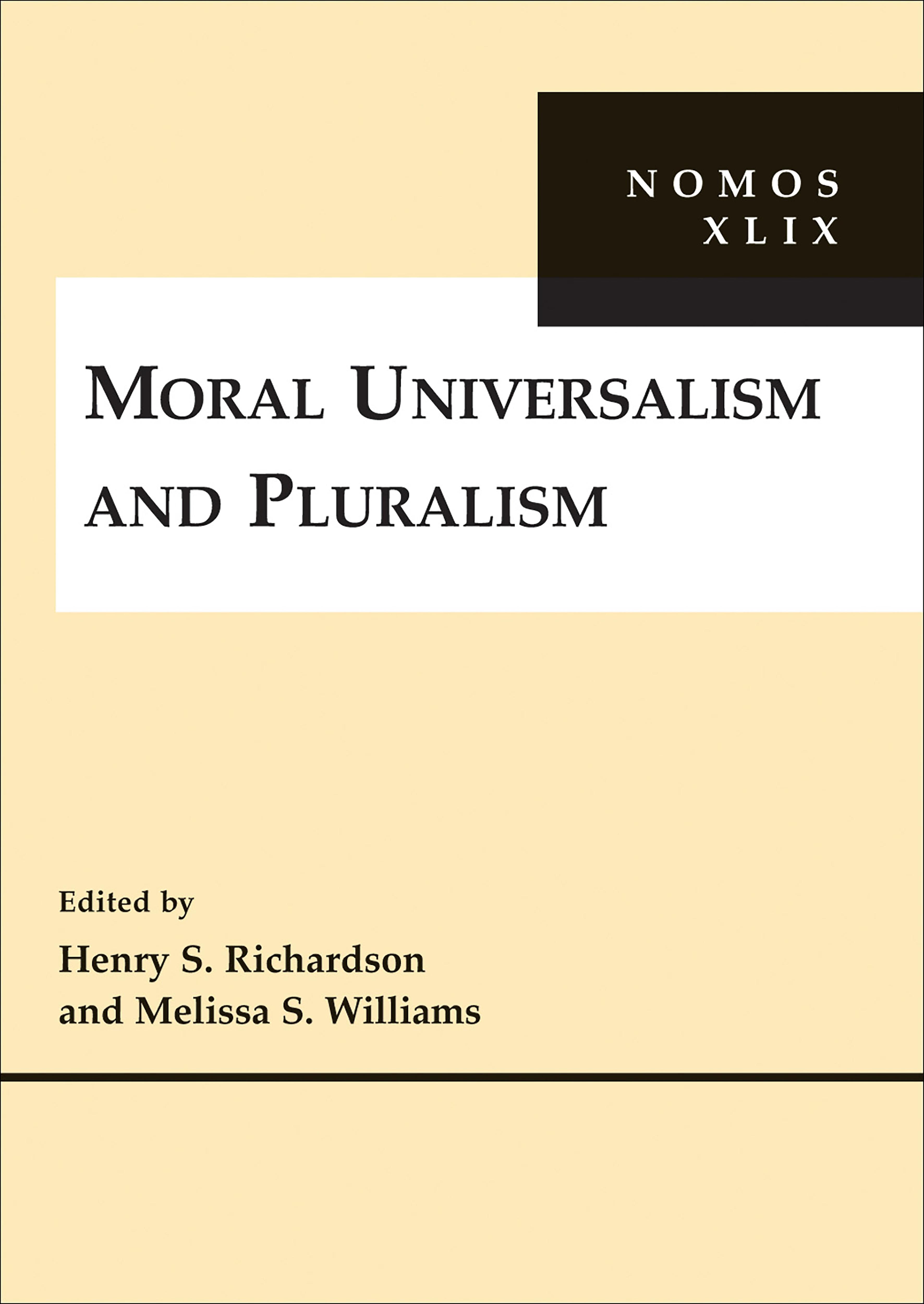
Moral universalism, or the idea that some system of ethics applies to all people regardless of race, color, nationality, religion, or culture, must have a plurality over which to range—a plurality of diverse persons, nations, jurisdictions, or localities over which morality asserts a universal authority. The contributors to Moral Universalism and Pluralism, the latest volume in the NOMOS series, investigate the idea that, far from denying the existence of such pluralities, moral universalism presupposes it. At the same time, the search for universally valid principles of morality is deeply challenged by diversity. The fact of pluralism presses us to explore how universalist principles interact with ethical, political, and social particularisms. These important essays refuse the answer that particularisms should simply be made to conform to universal principles, as if morality were a mold into which the diverse matter of human society and culture could be pressed. Rather, the authors bring philosophical, legal and political perspectives to bear on the core questions: Which forms of pluralism are conceptually compatible with moral universalism, and which ones can be accommodated in a politically stable way? Can pluralism generate innovations in understandings of moral duty? How is convergence on the validity of legal and moral authority possible in circumstances of pluralism? As the contributors to the book demonstrate in a wide variety of ways, these normative, conceptual, and political questions deeply intertwine.
Contributors: Kenneth Baynes, William A. Galston, Barbara Herman, F. M. Kamm, Benedict Kingsbury, Frank I. Michelman, William E. Scheuerman, Gopal Sreenivasan, Daniel Weinstock, and Robin West.
Pay easily by card, Klarna, Apple Pay or Google Pay. Not happy? You always have a 14-day money-back guarantee. Read more in our terms. If you have any questions, email us at hello@memmo.org.
Memmo makes studying easier – wherever you are in the world. We bring your course books and smart study tools together in one place: summaries, quizzes, podcasts and flashcards. Plus Ted, your study buddy who answers anything you wonder. Over 50,000 students already study here – built to help you learn faster and stress less.