
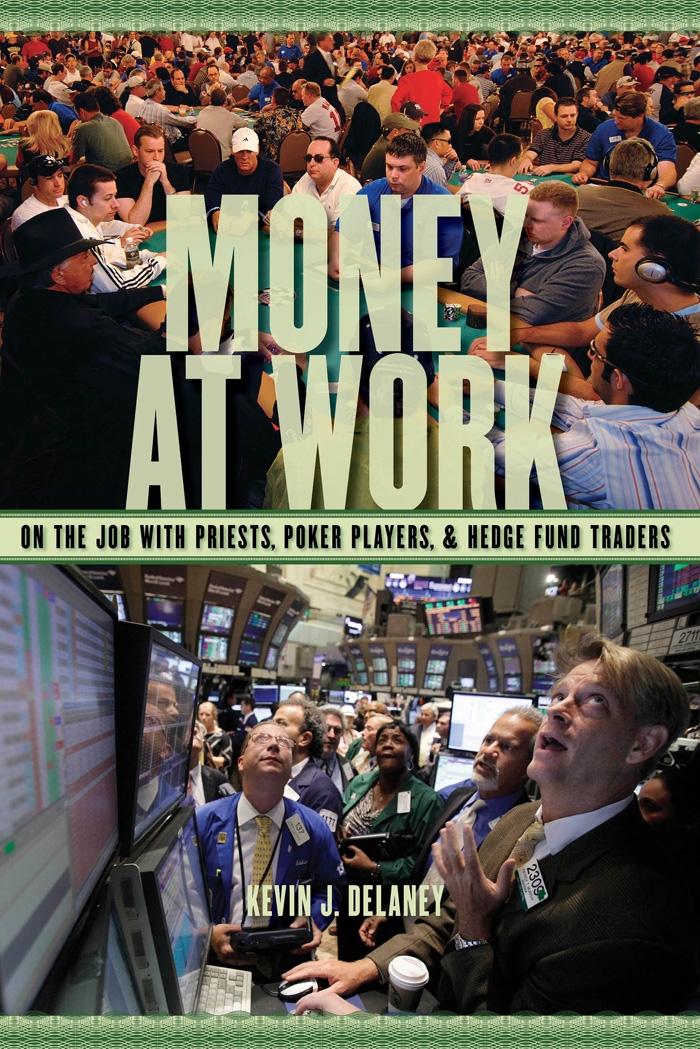
Financial advisors, poker players, hedge fund traders, fund-raisers, sports agents, credit counselors and commissioned salespeople all deal with one central concern in their jobs: money. In Money at Work, Kevin Delaney explores how we think about money
and, particularly, how our jobs influence that thinking. By spotlighting people for whom money is the focus of their work, Delaney illuminates how the daily practices experienced in different jobs create distinct ways of thinking and talking about money and how occupations and their work cultures carry important symbolic, material, and practical messages about money.
Delaney takes us deep inside the cultures of these ‘moneyed’ workers, using both interviews and first-hand observations of many of these occupations. From hedge fund trading rooms in New York, to poker players at work in Las Vegas casinos, to a “Christian money retreat” in a monastery in rural Pennsylvania, Delaney illustrates how the underlying economic conditions of various occupations and careers
produce what he calls “money cultures,” or ways of understanding the meaning of money, which in turn shape one’s economic outlook. Key to this is how some professionals, such as debt counselors, think very differently than say poker players in their regard to money—Delaney argues that it is the structure of these professions themselves that in turn influences monetary attitudes. Fundamentally, Money
at Work shows that what people do for a living has a profound effect on how people conceive of money both at work and in their home lives, making clear the connections between the economic and the social, shedding light on some of our most basic values. At a time when conversations about money are increasingly important, Delaney shows that we do not merely learn our attitudes toward money in childhood, but we also learn important money lessons from the work that we do.
Pay easily by card, Klarna, Apple Pay or Google Pay. Not happy? You always have a 14-day money-back guarantee. Read more in our terms. If you have any questions, email us at hello@memmo.org.
Memmo makes studying easier – wherever you are in the world. We bring your course books and smart study tools together in one place: summaries, quizzes, podcasts and flashcards. Plus Ted, your study buddy who answers anything you wonder. Over 50,000 students already study here – built to help you learn faster and stress less.