
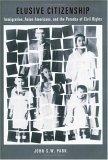
Since the late nineteenth century, federal and state rules governing immigration and naturalization have placed persons of Asian ancestry outside the boundaries of formal membership. A review of leading cases in American constitutional law regarding Asians would suggest that initially, Asian immigrants tended to evade exclusionary laws through deliberate misrepresentations of their identities or through extralegal means. Eventually, many of these immigrants and their descendants came to accept prevailing legal norms governing their citizenship in the United States. In many cases, this involved embracing notions of white supremacy.
John S. W. Park argues that American rules governing citizenship and belonging remain fundamentally unjust, even though they suggest the triumph of a "civil rights" vision, where all citizens share the same basic rights. By continuing to privilege members over non-members in ways that are politically popular, these rules mask injustices that violate principles of fairness. Importantly, Elusive Citizenship also suggests that politically and socially, full membership in American society remains closely linked with participation in exclusionary practices that isolate racial minorities in America.
Pay easily by card, Klarna, Apple Pay or Google Pay. Not happy? You always have a 14-day money-back guarantee. Read more in our terms. If you have any questions, email us at hello@memmo.org.
Memmo makes studying easier – wherever you are in the world. We bring your course books and smart study tools together in one place: summaries, quizzes, podcasts and flashcards. Plus Ted, your study buddy who answers anything you wonder. Over 50,000 students already study here – built to help you learn faster and stress less.