
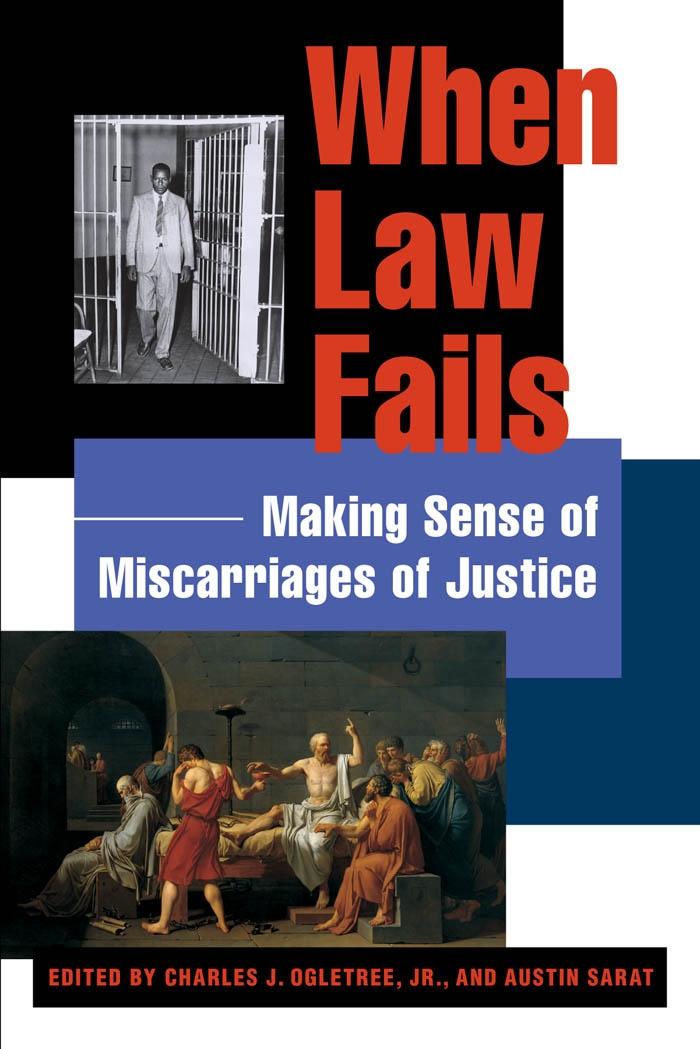
Since 1989, there have been over 200 post-conviction DNA exonerations in the United States. On the surface, the release of innocent people from prison could be seen as a victory for the criminal justice system: the wrong person went to jail, but the mistake was fixed and the accused set free. A closer look at miscarriages of justice, however, reveals that such errors are not aberrations but deeply revealing, common features of our legal system.
The ten original essays in When Law Fails view wrongful convictions not as random mistakes but as organic outcomes of a misshaped larger system that is rife with faulty eyewitness identifications, false confessions, biased juries, and racial discrimination. Distinguished legal thinkers Charles J. Ogletree, Jr., and Austin Sarat have assembled a stellar group of contributors who try to make sense of justice gone wrong and to answer urgent questions. Are miscarriages of justice systemic or symptomatic, or are they mostly idiosyncratic? What are the broader implications of justice gone awry for the ways we think about law? Are there ways of reconceptualizing legal missteps that are particularly useful or illuminating? These instructive essays both address the questions and point the way toward further discussion.
When Law Fails reveals the dramatic consequences as well as the daily realities of breakdowns in the law’s ability to deliver justice swiftly and fairly, and calls on us to look beyond headline-grabbing exonerations to see how failure is embedded in the legal system itself. Once we are able to recognize miscarriages of justice we will be able to begin to fix our broken legal system.
Contributors: Douglas A. Berman, Markus D. Dubber, Mary L. Dudziak, Patricia Ewick, Daniel Givelber, Linda Ross Meyer, Charles J. Ogletree, Jr., Austin Sarat, Jonathan Simon, and Robert Weisberg.
Pay easily by card, Klarna, Apple Pay or Google Pay. Not happy? You always have a 14-day money-back guarantee. Read more in our terms. If you have any questions, email us at hello@memmo.org.
Memmo makes studying easier – wherever you are in the world. We bring your course books and smart study tools together in one place: summaries, quizzes, podcasts and flashcards. Plus Ted, your study buddy who answers anything you wonder. Over 50,000 students already study here – built to help you learn faster and stress less.