
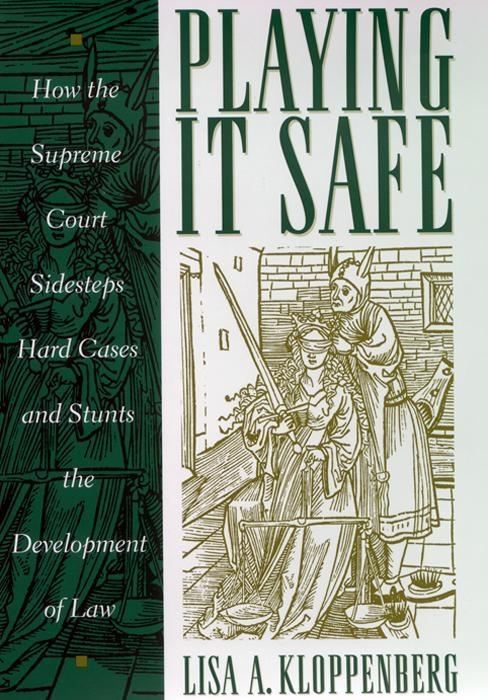
It is one of the unspoken truths of the American judicial system that courts go out of their way to avoid having to decide important and controversial issues. Even the Supreme Court from which the entire nation seeks guidance frequently engages in transparent tactics to avoid difficult, politically sensitive cases.
The Court's reliance on avoidance has been inconsistent and at times politically motivated. For example, liberal New Deal Justices, responding to the activism of a conservative Court, promoted deference to Congress and the presidency to protect the Court from political pressure. Likewise, as the Warren Court recognized new constitutional rights, conservative judges and critics praised avoidance as a foundational rule of judicial restraint. And as conservative Justices have constituted the majority on the Court in recent years, many liberals and moderates have urged avoidance, for fear of disagreeable verdicts.
By sharing the stories of litigants who struggled unsuccessfully to raise before the Supreme Court constitutional matters of the utmost importance from the 1970s-1990s, Playing it Safe argues that judges who fail to exercise their power in hard cases in effect abdicate their constitutional responsibility when it is needed most, and in so doing betray their commitment to neutrality. Lisa Kloppenberg demonstrates how the Court often avoids socially sensitive cases, such as those involving racial and ethnic discrimination, gender inequalities, abortion restrictions, sexual orientation discrimination, and environmental abuses. In the process, the Court ducks its responsibility to check the more politically responsive branches of government when "majority rule" pushes the boundaries of constitutional law. The Court has not used these malleable doctrines evenhandedly: it has actively shielded states from liability and national oversight, and aggressively expanded standing requirements to limit the role of federal courts.
Pay easily by card, Klarna, Apple Pay or Google Pay. Not happy? You always have a 14-day money-back guarantee. Read more in our terms. If you have any questions, email us at hello@memmo.org.
Memmo makes studying easier – wherever you are in the world. We bring your course books and smart study tools together in one place: summaries, quizzes, podcasts and flashcards. Plus Ted, your study buddy who answers anything you wonder. Over 50,000 students already study here – built to help you learn faster and stress less.