
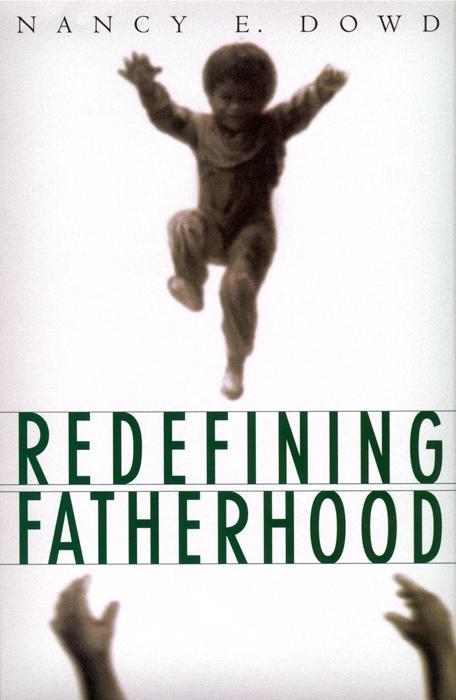
Most fathers parent less than most mothers. Those fathers who do parent equally or more so than mothers are poorly supported by our society. For children this means a loss of adult care, as well as an ongoing and sharply defined differentiation between fathers and mothers. Fathers are not present in children's lives to a significant degree, if at all, or when they are present, they are often rendered socially invisible. For many men, their parenthood is defined as biological or economic, while a minority of men struggle against the presumption that they are not caregivers.
In Redefining Fatherhood, Nancy Dowd argues that this skewed social pattern is mirrored and supported by law. Dowd makes the case for reenvisioning fatherhood away from genes and dollars, and toward nurture. Integrating economic, social and legal aspects of fathering, she makes the case for focusing on social, nurturing behavior as the core meaning of fatherhood. In this nuanced and complex analysis, she explores the barriers to redefinition, including concepts of masculinity, the interconnections between fathers and mothers, male violence and homophobia.
Redefining Fatherhood offers a progressive view on how men, and society at large, can change understandings and practices of fatherhood.
Pay easily by card, Klarna, Apple Pay or Google Pay. Not happy? You always have a 14-day money-back guarantee. Read more in our terms. If you have any questions, email us at hello@memmo.org.
Memmo makes studying easier – wherever you are in the world. We bring your course books and smart study tools together in one place: summaries, quizzes, podcasts and flashcards. Plus Ted, your study buddy who answers anything you wonder. Over 50,000 students already study here – built to help you learn faster and stress less.