
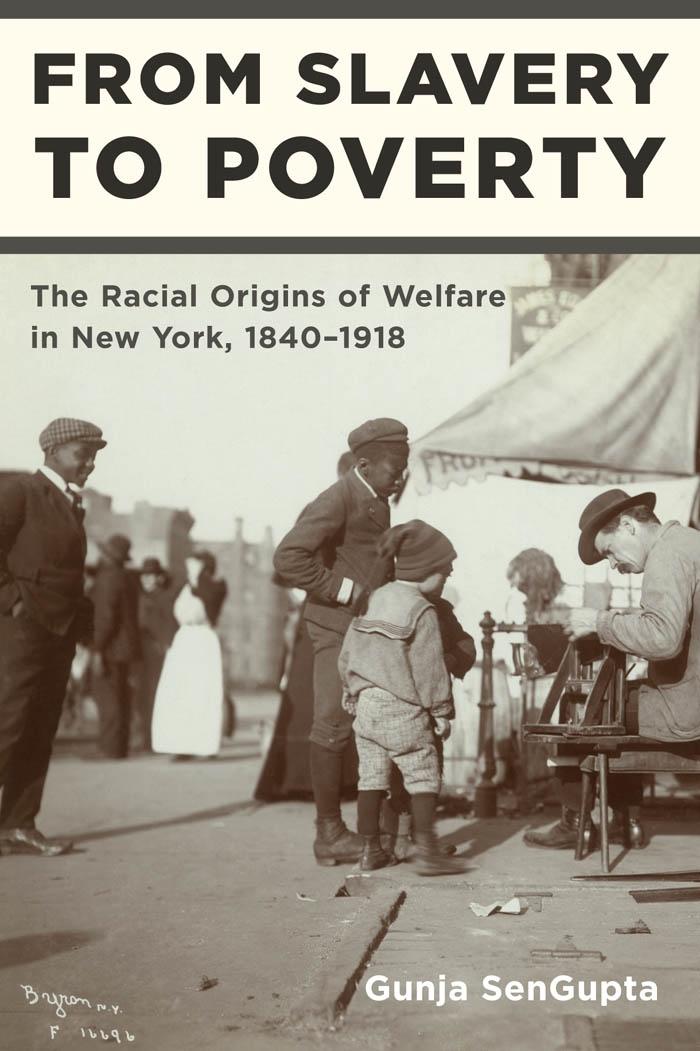
The racially charged stereotype of "welfare queen"—an allegedly promiscuous waster who uses her children as meal tickets funded by tax-payers—is a familiar icon in modern America, but as Gunja SenGupta reveals in From Slavery to Poverty, her historical roots run deep. For, SenGupta argues, the language and institutions of poor relief and reform have historically served as forums for inventing and negotiating identity.
Mining a broad array of sources on nineteenth-century New York City’s interlocking network of private benevolence and municipal relief, SenGupta shows that these institutions promoted a racialized definition of poverty and citizenship. But they also offered a framework within which working poor New Yorkers—recently freed slaves and disfranchised free blacks, Afro-Caribbean sojourners and Irish immigrants, sex workers and unemployed laborers, and mothers and children—could challenge stereotypes and offer alternative visions of community. Thus, SenGupta argues, long before the advent of the twentieth-century welfare state, the discourse of welfare in its nineteenth-century incarnation created a space to talk about community, race, and nation; about what it meant to be “American,” who belonged, and who did not. Her work provides historical context for understanding why today the notion of "welfare"—with all its derogatory “un-American” connotations—is associated not with middle-class entitlements like Social Security and Medicare, but rather with programs targeted at the poor, which are wrongly assumed to benefit primarily urban African Americans.
Pay easily by card, Klarna, Apple Pay or Google Pay. Not happy? You always have a 14-day money-back guarantee. Read more in our terms. If you have any questions, email us at hello@memmo.org.
Memmo makes studying easier – wherever you are in the world. We bring your course books and smart study tools together in one place: summaries, quizzes, podcasts and flashcards. Plus Ted, your study buddy who answers anything you wonder. Over 50,000 students already study here – built to help you learn faster and stress less.