
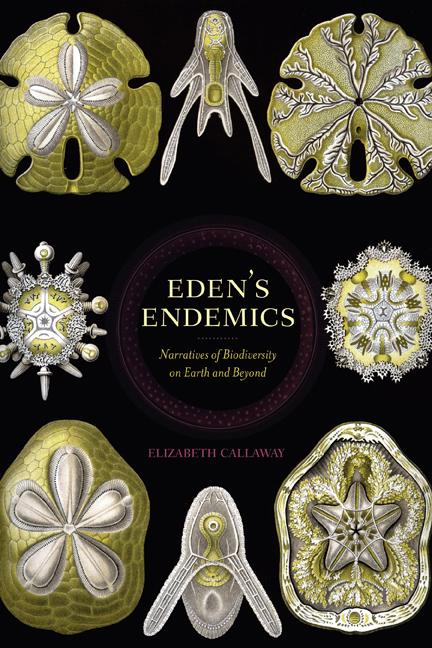
In the past thirty years biodiversity has become one of the central organizing principles through which we understand the nonhuman environment. Its deceptively simple definition as the variation among living organisms masks its status as a hotly contested term both within the sciences and more broadly. In Eden’s Endemics, Elizabeth Callaway looks to cultural objects—novels, memoirs, databases, visualizations, and poetry— that depict many species at once to consider the question of how we narrate organisms in their multiplicity.
Touching on topics ranging from seed banks to science fiction to bird-watching, Callaway argues that there is no set, generally accepted way to measure biodiversity. Westerners tend to conceptualize it according to one or more of an array of tropes rooted in colonial history such as the Lost Eden, Noah’s Ark, and Tree-of-Life imagery. These conceptualizations affect what kinds of biodiversities are prioritized for protection. While using biodiversity as a way to talk about the world aims to highlight what is most valued in nature, it can produce narratives that reinforce certain power differentials—with real-life consequences for conservation projects. Thus the choices made when portraying biodiversity impact what is visible, what is visceral, and what is unquestioned common sense about the patterns of life on Earth.
Pay easily by card, Klarna, Apple Pay or Google Pay. Not happy? You always have a 14-day money-back guarantee. Read more in our terms. If you have any questions, email us at hello@memmo.org.
Memmo makes studying easier – wherever you are in the world. We bring your course books and smart study tools together in one place: summaries, quizzes, podcasts and flashcards. Plus Ted, your study buddy who answers anything you wonder. Over 50,000 students already study here – built to help you learn faster and stress less.