
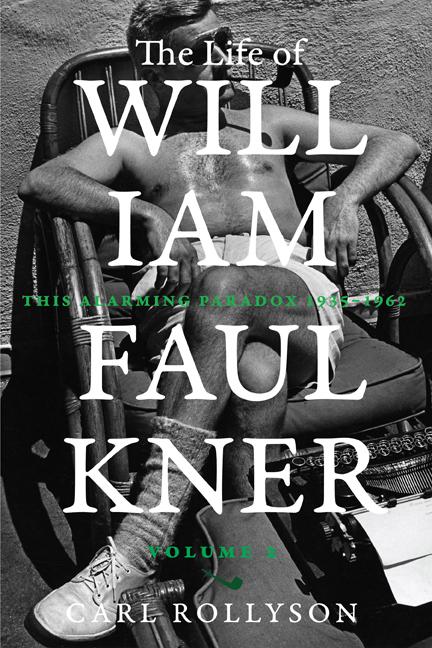
By the end of volume 1 of The Life of William Faulkner ("A filling, satisfying feast for Faulkner aficianados"— Kirkus), the young Faulkner had gone from an unpromising, self-mythologizing bohemian to the author of some of the most innovative and enduring literature of the century, including The Sound and the Fury and Light in August. The second and concluding volume of Carl Rollyson’s ambitious biography finds Faulkner lamenting the many threats to his creative existence. Feeling, as an artist, he should be above worldly concerns and even morality, he has instead inherited only debts—a symptom of the South’s faded fortunes—and numerous mouths to feed and funerals to fund. And so he turns to the classic temptation for financially struggling writers—Hollywood.
Thus begins roughly a decade of shuttling between his home and family in Mississippi—lifeblood of his art—and the backlots of the Golden Age film industry. Through Faulkner’s Hollywood years, Rollyson introduces such personalities as Humphrey Bogart and Faulkner’s long-time collaborator Howard Hawks, while telling the stories behind films such as The Big Sleep and To Have and Have Not. At the same time, he chronicles with great insight Faulkner's rapidly crumbling though somehow resilient marriage and his numerous extramarital affairs--including his deeply felt, if ultimately doomed, relationship with Meta Carpenter. (In his grief over their breakup, Faulkner—a dipsomaniac capable of ferocious alcoholic binges—received third-degree burns when he passed out on a hotel-room radiator.)
Where most biographers and critics dismiss Faulkner’s film work as at best a necessary evil, at worst a tragic waste of his peak creative years, Rollyson approaches this period as a valuable window on his artistry. He reveals a fascinating, previously unappreciated cross-pollination between Faulkner’s film and literary work, elements from his fiction appearing in his screenplays and his film collaborations influencing his later novels—fundamentally changing the character of late-career works such as the Snopes trilogy.
Rollyson takes the reader on a fascinating journey through the composition of Absalom, Absalom!, widely considered Faulkner’s masterpiece, as well as the film adaptation he authored—unproduced and never published— Revolt in the Earth. He reveals how Faulkner wrestled with the legacy of the South—both its history and its dizzying racial contradictions—and turned it into powerful art in works such as Go Down, Moses and Intruder in the Dust.
Volume 2 of this monumental work rests on an unprecedented trove of research, giving us the most penetrating and comprehensive life of Faulkner and providing a fascinating look at the author's trajectory from under-appreciated "writer's writer" to world-renowned Nobel laureate and literary icon. In his famous Nobel speech, Faulkner said what inspired him was the human ability to prevail. In the end, this beautifully wrought life shows how Faulkner, the man and the artist, embodies this remarkable capacity to endure and prevail.
Pay easily by card, Klarna, Apple Pay or Google Pay. Not happy? You always have a 14-day money-back guarantee. Read more in our terms. If you have any questions, email us at hello@memmo.org.
Memmo makes studying easier – wherever you are in the world. We bring your course books and smart study tools together in one place: summaries, quizzes, podcasts and flashcards. Plus Ted, your study buddy who answers anything you wonder. Over 50,000 students already study here – built to help you learn faster and stress less.