
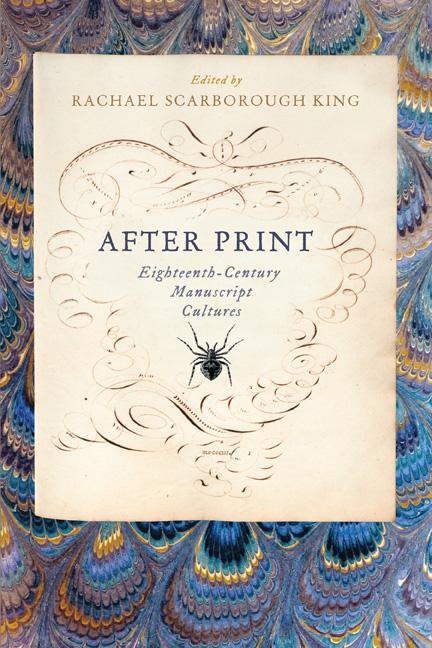
The eighteenth century has generally been understood as the Age of Print, when the new medium revolutionized the literary world and rendered manuscript culture obsolete. After Print, however, reveals that the story isn’t so simple. Manuscript remained a vital, effective, and even preferred forum for professional and amateur authors working across fields such as literature, science, politics, religion, and business through the Romantic period.
The contributors to this book offer a survey of the manuscript culture of the time, discussing handwritten culinary recipes, the poetry of John Keats, Benjamin Franklin’s letters about his electrical experiments, and more. Collectively, the essays demonstrate that what has often been seen as the amateur, feminine, and aristocratic world of handwritten exchange thrived despite the spread of the printed word. In so doing, they undermine the standard print-manuscript binary and advocate for a critical stance that better understands the important relationship between the media.
Bringing together work from literary scholars, librarians, and digital humanists, the diverse essays in After Print offer a new model for archival research, pulling from an exciting variety of fields to demonstrate that manuscript culture did not die out but, rather, may have been revitalized by the advent of printing.
Contributors: Leith Davis, Simon Fraser University * Margaret J. M. Ezell, Texas A&M University * Emily C. Friedman, Auburn University * Kathryn R. King, University of Montevallo * Michelle Levy, Simon Fraser University * Marissa Nicosia, Penn State Abington * Philip S. Palmer, Morgan Library and Museum * Colin T. Ramsey, Appalachian State University * Brian Rejack, Illinois State University * Beth Fowkes Tobin, University of Georgia * Andrew O. Winckles, Adrian College
Pay easily by card, Klarna, Apple Pay or Google Pay. Not happy? You always have a 14-day money-back guarantee. Read more in our terms. If you have any questions, email us at hello@memmo.org.
Memmo makes studying easier – wherever you are in the world. We bring your course books and smart study tools together in one place: summaries, quizzes, podcasts and flashcards. Plus Ted, your study buddy who answers anything you wonder. Over 50,000 students already study here – built to help you learn faster and stress less.