
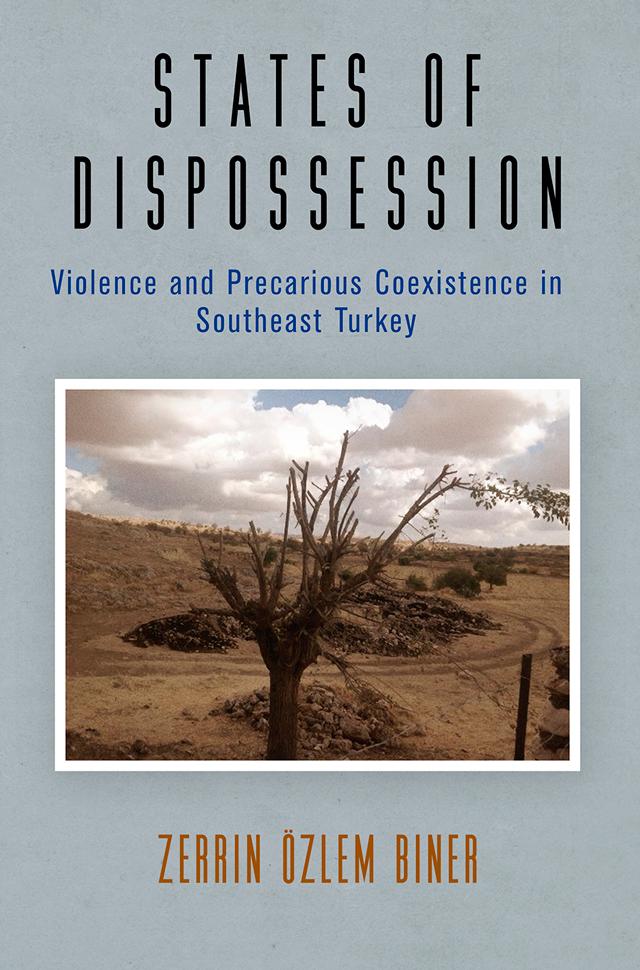
Traces the violence of the protracted conflict in the Kurdish region of Turkey through the lens of dispossession
The military conflict between the Kurdistan Workers' Party (PKK) and the Turkish Armed Forces has endured over the course of the past three decades. Since 1984, the conflict has claimed the lives of more than 45,000 civilians, militants, and soldiers, as well as causing thousands of casualties and disappearances. It has led to the displacement of millions of people and caused the forced evacuation of nearly 4,000 villages and towns. Suspended periodically by various cease-fires, the conflict has been a significant force in shaping many of the ethnic, social, and political enclaves of contemporary Turkey, where contradictory forms of governance have been installed across the Kurdish region.
In States of Dispossession, Zerrin Özlem Biner traces the violence of the protracted conflict in the Kurdish region through the lens of dispossession. By definition, dispossession implies the act of depriving someone of land, property, and other belongings as well as the result of such deprivation. Within the fields of Ottoman and contemporary Turkish studies, social scientists to date have examined the dispossession of rights and property as a technique for governing territory and those citizens living at its margins. States of Dispossession instead highlights everyday experiences in an attempt to understand the persistent and intangible effects of dispossession. Biner examines the practices and discourses that emerge from local memories of unspoken, irresolvable histories and the ways people of differing religious and ethnic backgrounds live with the remains of violence that is still unfolding. She explores the implicit knowledge held by ordinary people about the landscape and the built environment and the continuous struggle to reclaim rights over dispossessed bodies and places.
Pay easily by card, Klarna, Apple Pay or Google Pay. Not happy? You always have a 14-day money-back guarantee. Read more in our terms. If you have any questions, email us at hello@memmo.org.
Memmo makes studying easier – wherever you are in the world. We bring your course books and smart study tools together in one place: summaries, quizzes, podcasts and flashcards. Plus Ted, your study buddy who answers anything you wonder. Over 50,000 students already study here – built to help you learn faster and stress less.