
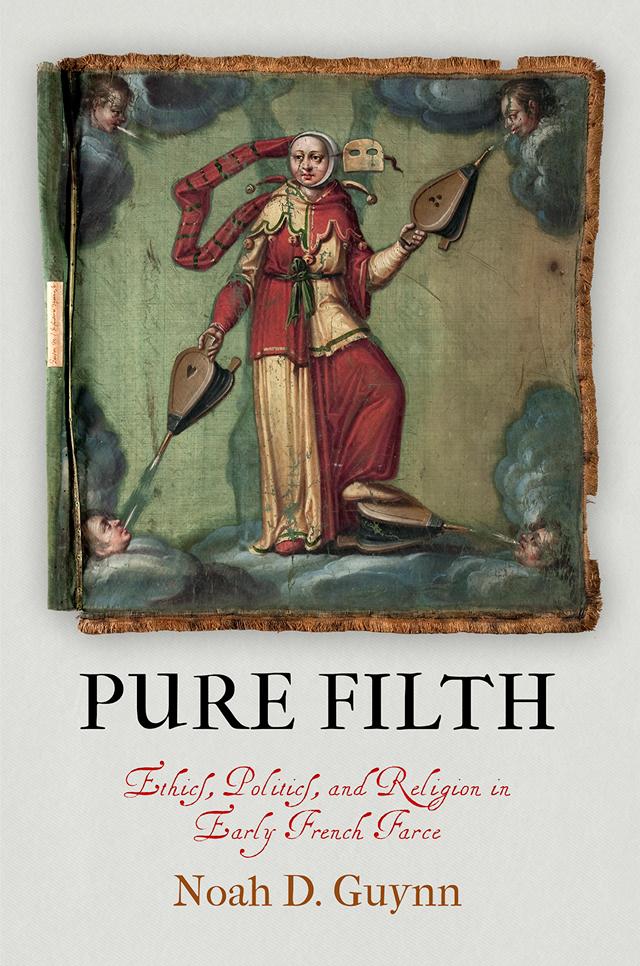
As Noah D. Guynn observes, early French farce has been summarily dismissed as filth for centuries. Renaissance humanists, classical moralists, and Enlightenment philosophes belittled it as an embarrassing reminder of the vulgarity of medieval popular culture. Modern literary critics and theater historians often view it as comedy's poor relation—trite, smutty pap that served to divert the masses and to inure them to lives of subservience. Yet, as Guynn demonstrates in his reexamination of the genre, the superficial crudeness and predictability of farce belie the complexities of its signifying and performance practices and the dynamic, contested nature of its field of reception. Pure Filth focuses on overlooked and occluded content in farce, arguing that apparently coarse jokes conceal finely drawn, and sometimes quite radical, perspectives on ethics, politics, and religion.
Engaging with cultural history, political anthropology, and critical, feminist, and queer theory, Guynn shows that farce does not pander to the rabble in order to cultivate acquiescence or curb dissent. Rather, it uses the tools of comic theater—parody and satire, imitation and exaggeration, cross-dressing and masquerade—to address the urgent issues its spectators faced in their everyday lives: economic inequality and authoritarian rule, social justice and ethical renewal, sacramental devotion and sacerdotal corruption, and heterosocial relations and household politics. Achieving its subtlest effects by employing the lewdest forms of humor, farce reveals that aspirations to purity, whether ethical, political, or religious, are inevitably mired in the very filth they repudiate.
Pay easily by card, Klarna, Apple Pay or Google Pay. Not happy? You always have a 14-day money-back guarantee. Read more in our terms. If you have any questions, email us at hello@memmo.org.
Memmo makes studying easier – wherever you are in the world. We bring your course books and smart study tools together in one place: summaries, quizzes, podcasts and flashcards. Plus Ted, your study buddy who answers anything you wonder. Over 75,000 students already study here – built to help you learn faster and stress less.