
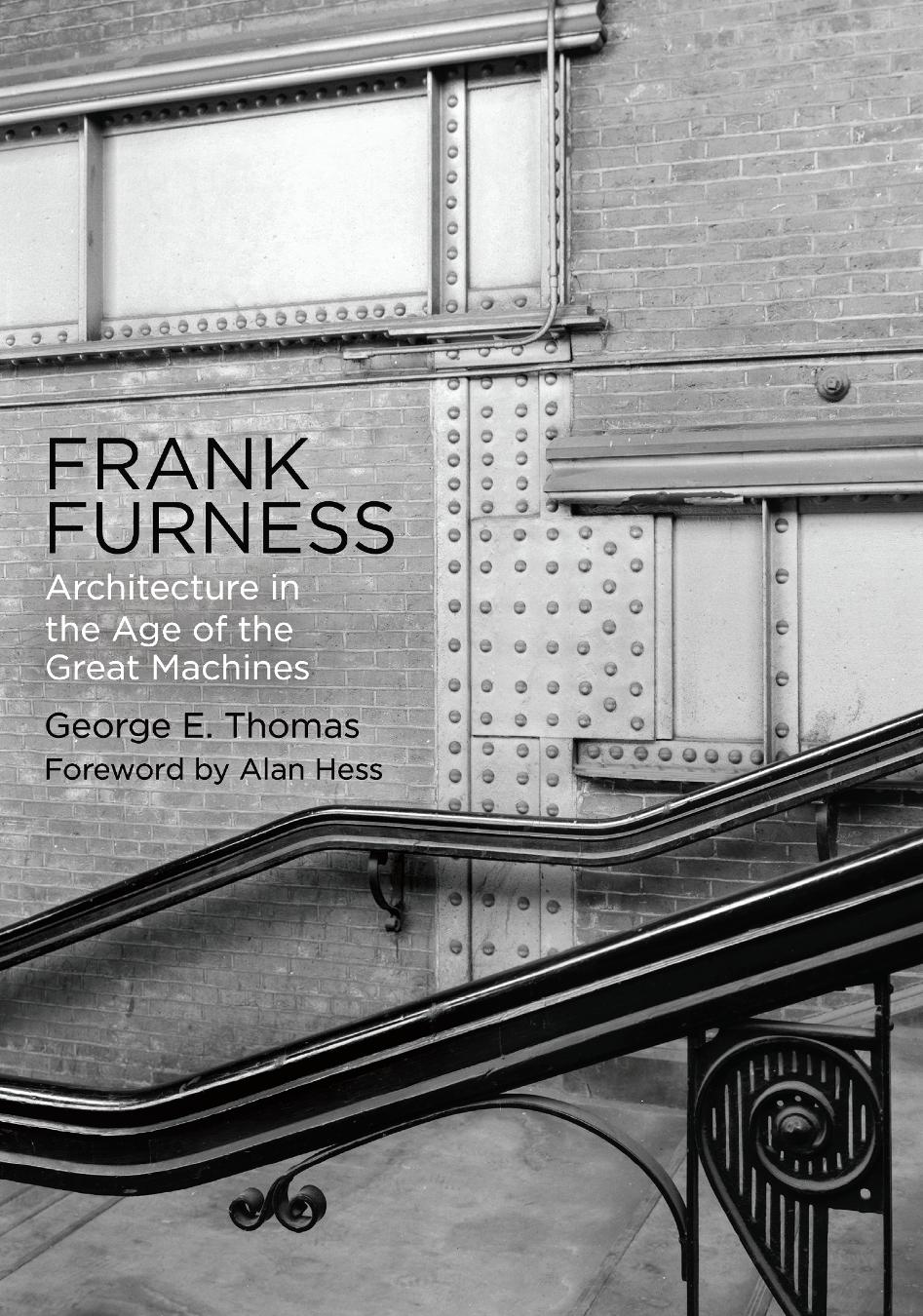
Frank Furness (1839-1912) has remained a curiosity to architectural historians and critics, somewhere between an icon and an enigma, whose importance and impact have yet to be properly evaluated or appreciated. To some, his work pushed pattern and proportion to extremes, undermining or forcing together the historic styles he referenced in such eclectic buildings as the Pennsylvania Academy of the Fine Arts and the University of Pennsylvania Library. To others, he was merely a regional mannerist creating an eccentric personal style that had little resonance and modest influence on the future of architecture. By placing Furness in the industrial culture that supported his work, George Thomas finds a cutting-edge revolutionary who launched the beginnings of modern design, played a key part in its evolution, and whose strategies continue to affect the built world.
In his sweeping reassessment of Furness as an architect of the machine age, Thomas grounds him in Philadelphia, a city led by engineers, industrialists, and businessmen who commissioned the buildings that extended modern design to Chicago, Glasgow, and Berlin. Thomas examines the multiple facets of Victorian Philadelphia's modernity, looking to its eager embrace of innovations in engineering, transportation, technology, and building, and argues that Furness, working for a particular cohort of clients, played a central role in shaping this context. His analyses of the innovative planning, formal, and structural qualities of Furness's major buildings identifies their designs as initiators of a narrative that leads to such more obviously modern figures as Louis Sullivan, William Price, Frank Lloyd Wright and eventually, the architects of the Bauhaus.
Misunderstood and reviled in the traditional architectural centers of New York and Boston, Furness's projects, commissioned by the progressive industrialists of the new machine age, intentionally broke with the historical styles of the past to work in a modern way—from utilizing principles based on logistical planning to incorporating the new materials of the industrial age. Lavishly illustrated, the book includes more than eighty black-and-white and thirty color photographs that highlight the richness of his work and the originality of his design spanning more than forty years.
Pay easily by card, Klarna, Apple Pay or Google Pay. Not happy? You always have a 14-day money-back guarantee. Read more in our terms. If you have any questions, email us at hello@memmo.org.
Memmo makes studying easier – wherever you are in the world. We bring your course books and smart study tools together in one place: summaries, quizzes, podcasts and flashcards. Plus Ted, your study buddy who answers anything you wonder. Over 75,000 students already study here – built to help you learn faster and stress less.