
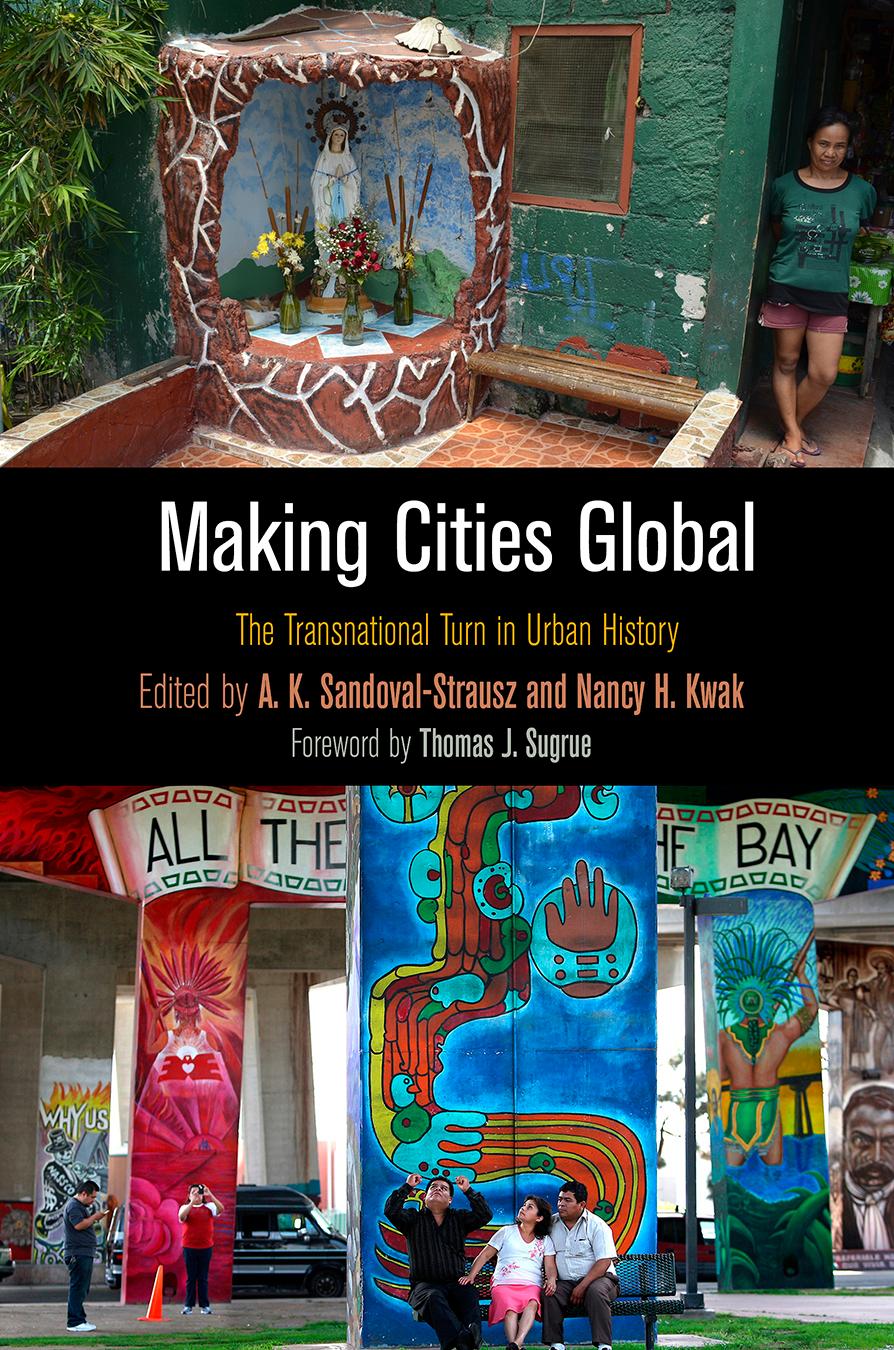
In recent decades, hundreds of millions of people across the world have moved from rural areas to metropolitan regions, some of them crossing national borders on the way. While urbanization and globalization are proceeding with an intensity that seems unprecedented, these are only the most recent iterations of long-term transformations—cities have for centuries served as vital points of contact between different peoples, economies, and cultures. Making Cities Global explores the intertwined development of urbanization and globalization using a historical approach that demonstrates the many forms transnationalism has taken, each shaped by the circumstances of a particular time and place. It also emphasizes that globalization has not been persistent or automatic—many people have been as likely to resist or reject outside connections as to establish or embrace them.
The essays in the collection revolve around three foundational themes. The first is an emphasis on connections among the United States, East and Southeast Asia, Latin America, and South Asia. Second, contributors ground their studies of globalization in the built environments and everyday interactions of the city, because even world-spanning practices must be understood as people experience them in their neighborhoods, workplaces, stores, and streets. Last is a fundamental concern with the role powerful empires and nation-states play in the emergence of globalizing and urbanizing processes.
Making Cities Global argues that combining urban history with a transnational approach leads to a richer understanding of our increasingly interconnected world. In order to achieve prosperity, peace, and sustainability in metropolitan areas in the present and into the future, we must understand their historical origins and development.
Contributors: Erica Allen-Kim, Leandro Benmergui, Matt Garcia, Richard Harris, Carola Hein, Nancy Kwak, Carl Nightingale, Amy C. Offner, Margaret O'Mara, Nikhil Rao, A. K. Sandoval-Strausz, Arijit Sen, Thomas J. Sugrue.
Pay easily by card, Klarna, Apple Pay or Google Pay. Not happy? You always have a 14-day money-back guarantee. Read more in our terms. If you have any questions, email us at hello@memmo.org.
Memmo makes studying easier – wherever you are in the world. We bring your course books and smart study tools together in one place: summaries, quizzes, podcasts and flashcards. Plus Ted, your study buddy who answers anything you wonder. Over 50,000 students already study here – built to help you learn faster and stress less.