
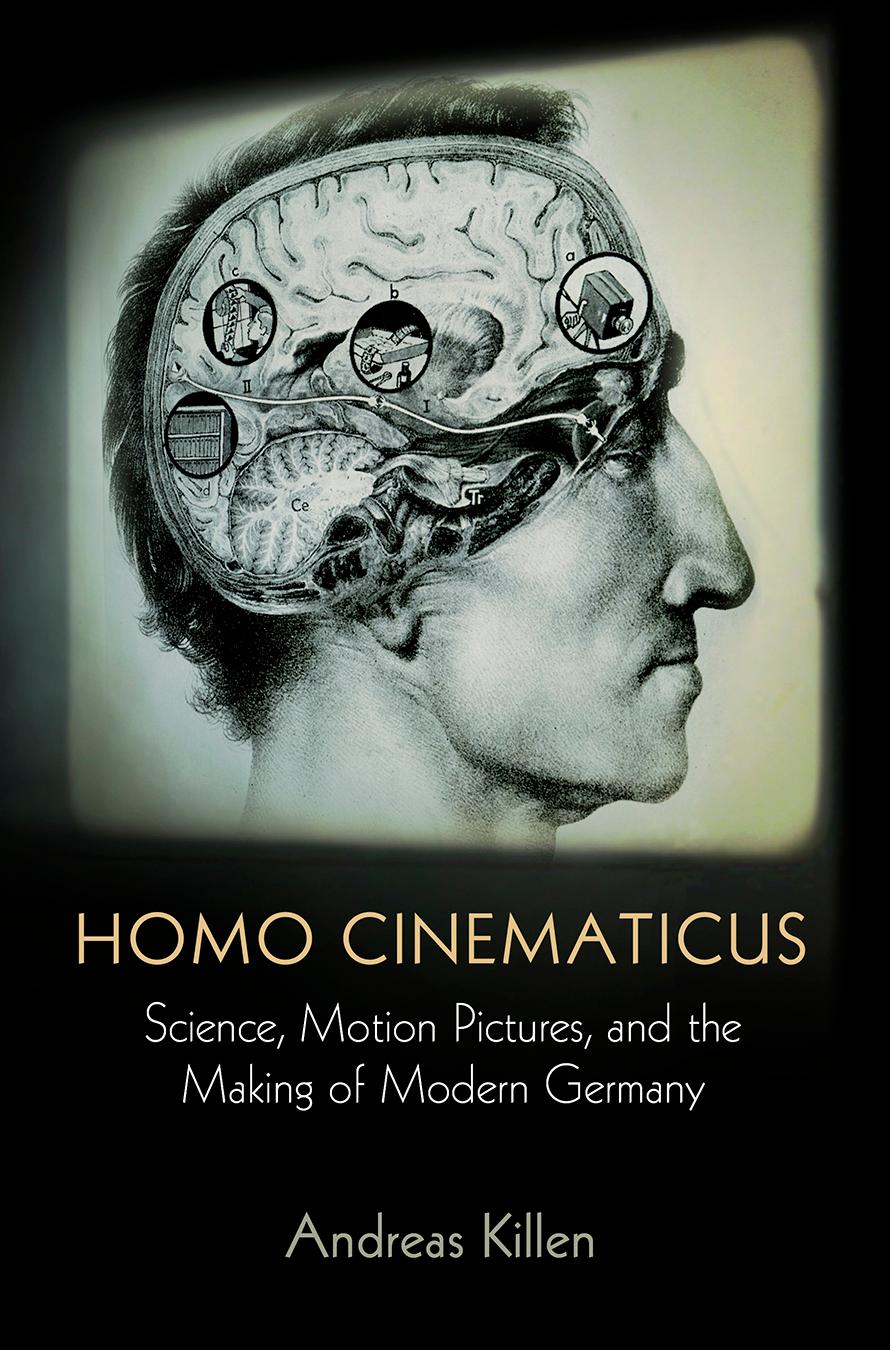
In the early decades of the twentieth century, two intertwined changes began to shape the direction of German society. The baptism of the German film industry took place amid post-World War I conditions of political and social breakdown, and the cultural vacuum left by collapsing institutions was partially filled by moving images. At the same time, the emerging human sciences—psychiatry, neurology, sexology, eugenics, industrial psychology, and psychoanalysis—began to play an increasingly significant role in setting the terms for the way Germany analyzed itself and the problems it had inherited from its authoritarian past, the modernizing process, and war. Moreover, in advancing their professional and social goals, these sciences became heavily reliant on motion pictures.
Situated at the intersection of film studies, the history of science and medicine, and the history of modern Germany, Homo Cinematicus connects the rise of cinema as a social institution to an inquiry into the history of knowledge production in the human sciences. Taking its title from a term coined in 1919 by commentator Wilhelm Stapel to identify a new social type that had been created by the emergence of cinema, Killen's book explores how a new class of experts in these new disciplines converged on the figure of the "homo cinematicus" and made him central to many of that era's major narratives and social policy initiatives.
Killen traces film's use by the human sciences as a tool for producing, communicating, and popularizing new kinds of knowledge, as well as the ways that this alliance was challenged by popular films that interrogated the truth claims of both modern science and scientific cinema. In doing so, Homo Cinematicus endeavors to move beyond the divide between scientific and popular film, examining their historical coexistence and coevolution.
Pay easily by card, Klarna, Apple Pay or Google Pay. Not happy? You always have a 14-day money-back guarantee. Read more in our terms. If you have any questions, email us at hello@memmo.org.
Memmo makes studying easier – wherever you are in the world. We bring your course books and smart study tools together in one place: summaries, quizzes, podcasts and flashcards. Plus Ted, your study buddy who answers anything you wonder. Over 50,000 students already study here – built to help you learn faster and stress less.