
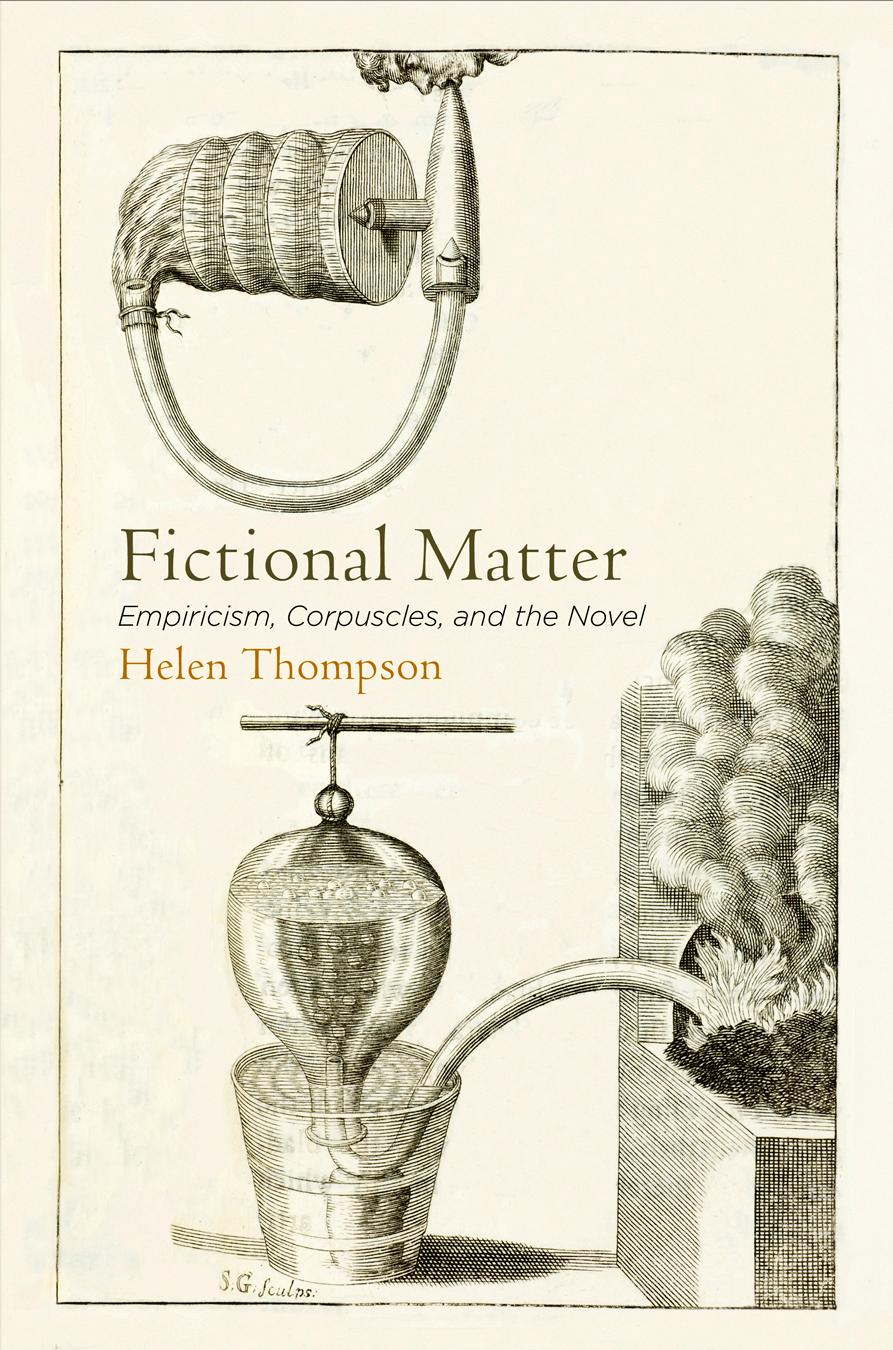
In a groundbreaking study of the relationship between chemistry and literary history, Helen Thompson explores the ways in which chemical conceptions of matter shaped eighteenth-century British culture. Although the scientific revolution championed experimental, sense-based knowledge, chemists claimed that perceptible bodies were made of invisible particles or "corpuscles." Neither modern elements nor classical atoms, corpuscles were reactive, divisible units of matter. Imperceptible but real, the corpuscle transformed empirical knowledge in early modern science and the novel.
Thompson offers new analyses of the chemistry, alchemy, color theory, physiology, environmental science, and medicine pioneered by Robert Boyle, Isaac Newton, Stephen Hales, John Mitchell, John Arbuthnot, and Thomas Sydenham to argue that they shaped cultural conceptions of racial, class, sex, and species identity. Juxtaposing science with readings of novels by Daniel Defoe, Eliza Haywood, Jonathan Swift, Samuel Richardson, Henry Fielding, William Rufus Chetwood, and Penelope Aubin, she shows how, at the level of form as well as character, novels represent perceptual knowledge that refers not to innate essence but to dynamic and unstable relations.
The realist narrative mode that experimental science bequeaths to literary history, Fictional Matter argues, does not transparently mirror perceptible objects. Instead, novels represent the forms and relations through which imperceptible particles stimulate sensory experience. In this lucid, revisionary analysis of corpuscular chemistry, Thompson advances a new account of the influence of experimental science and empirical knowledge on the emergent realist novel.
Pay easily by card, Klarna, Apple Pay or Google Pay. Not happy? You always have a 14-day money-back guarantee. Read more in our terms. If you have any questions, email us at hello@memmo.org.
Memmo makes studying easier – wherever you are in the world. We bring your course books and smart study tools together in one place: summaries, quizzes, podcasts and flashcards. Plus Ted, your study buddy who answers anything you wonder. Over 50,000 students already study here – built to help you learn faster and stress less.