
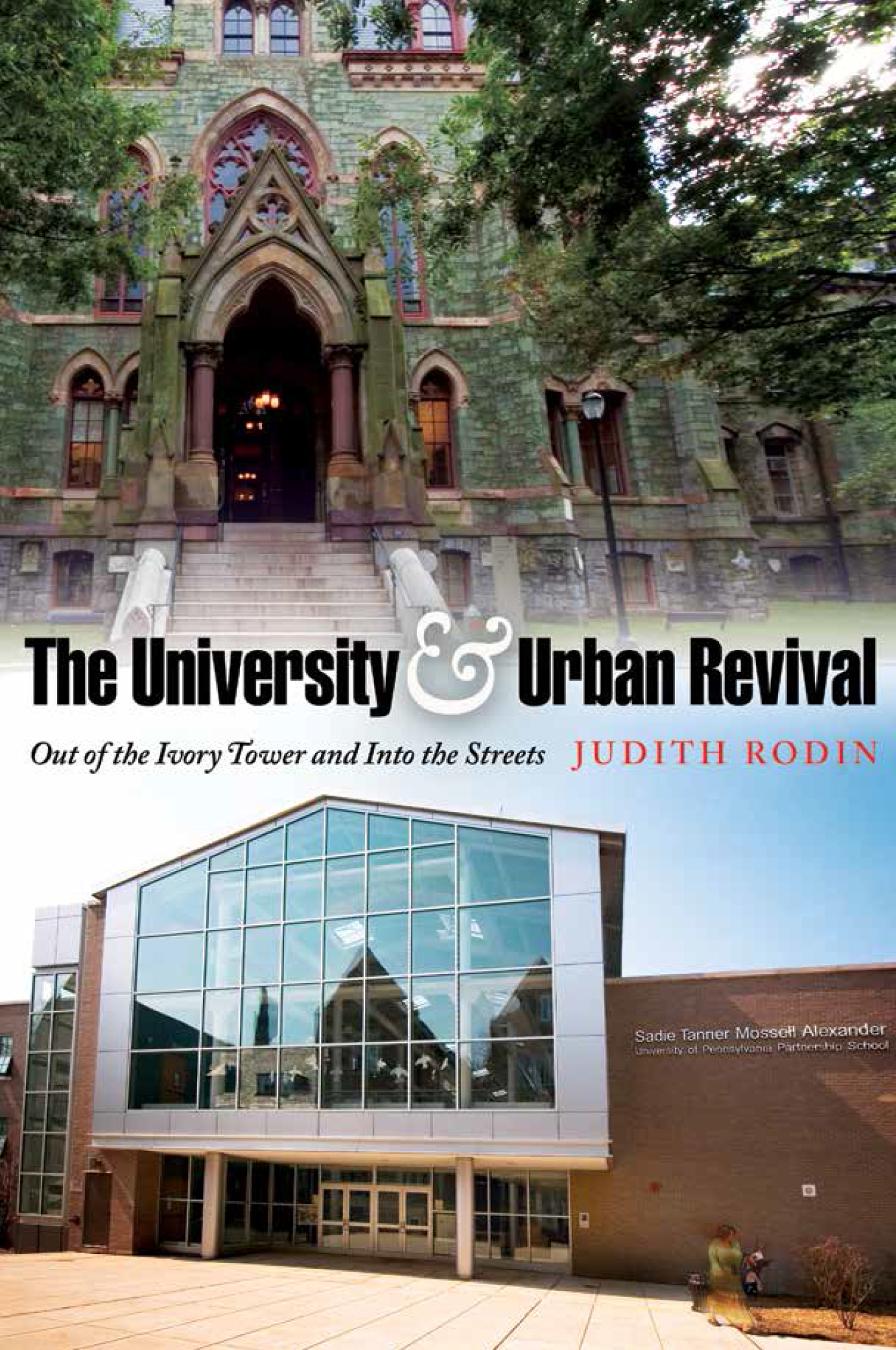
In the last quarter of the twentieth century, urban colleges and universities found themselves enveloped by the poverty, crime, and physical decline that afflicted American cities. Some institutions turned inward, trying to insulate themselves rather than address the problems in their own backyards. Others attempted to develop better community relations, though changes were hard to sustain.
Spurred by an unprecedented crime wave in 1996, University of Pennsylvania President Judith Rodin knew that the time for urgent action had arrived, and she set a new course of proactive community engagement for her university. Her dedication to the revitalization of West Philadelphia was guided by her role not only as president but also as a woman and a mother with a deep affection for her hometown.
The goal was to build capacity back into a severely distressed inner-city neighborhood—educational capacity, retail capacity, quality-of-life capacity, and especially economic capacity—guided by the belief that "town and gown" could unite as one richly diverse community.
Cities rely on their academic institutions as stable places of employment, cultural centers, civic partners, and concentrated populations of consumers for local business and services. And a competitive university demands a vibrant neighborhood to meet the needs of its faculty, staff, and students. In keeping with their mission, urban universities are uniquely positioned to lead their communities in revitalization efforts, yet this effort requires resolute persistence.
During Rodin's administration (1994-2004), the Chronicle of Higher Education referred to Penn's progress as a "national model of constructive town-gown interaction and partnership." This book narrates the challenges, frustrations, and successes of Penn's campaign, and its prospects for long-term change.
Pay easily by card, Klarna, Apple Pay or Google Pay. Not happy? You always have a 14-day money-back guarantee. Read more in our terms. If you have any questions, email us at hello@memmo.org.
Memmo makes studying easier – wherever you are in the world. We bring your course books and smart study tools together in one place: summaries, quizzes, podcasts and flashcards. Plus Ted, your study buddy who answers anything you wonder. Over 50,000 students already study here – built to help you learn faster and stress less.