
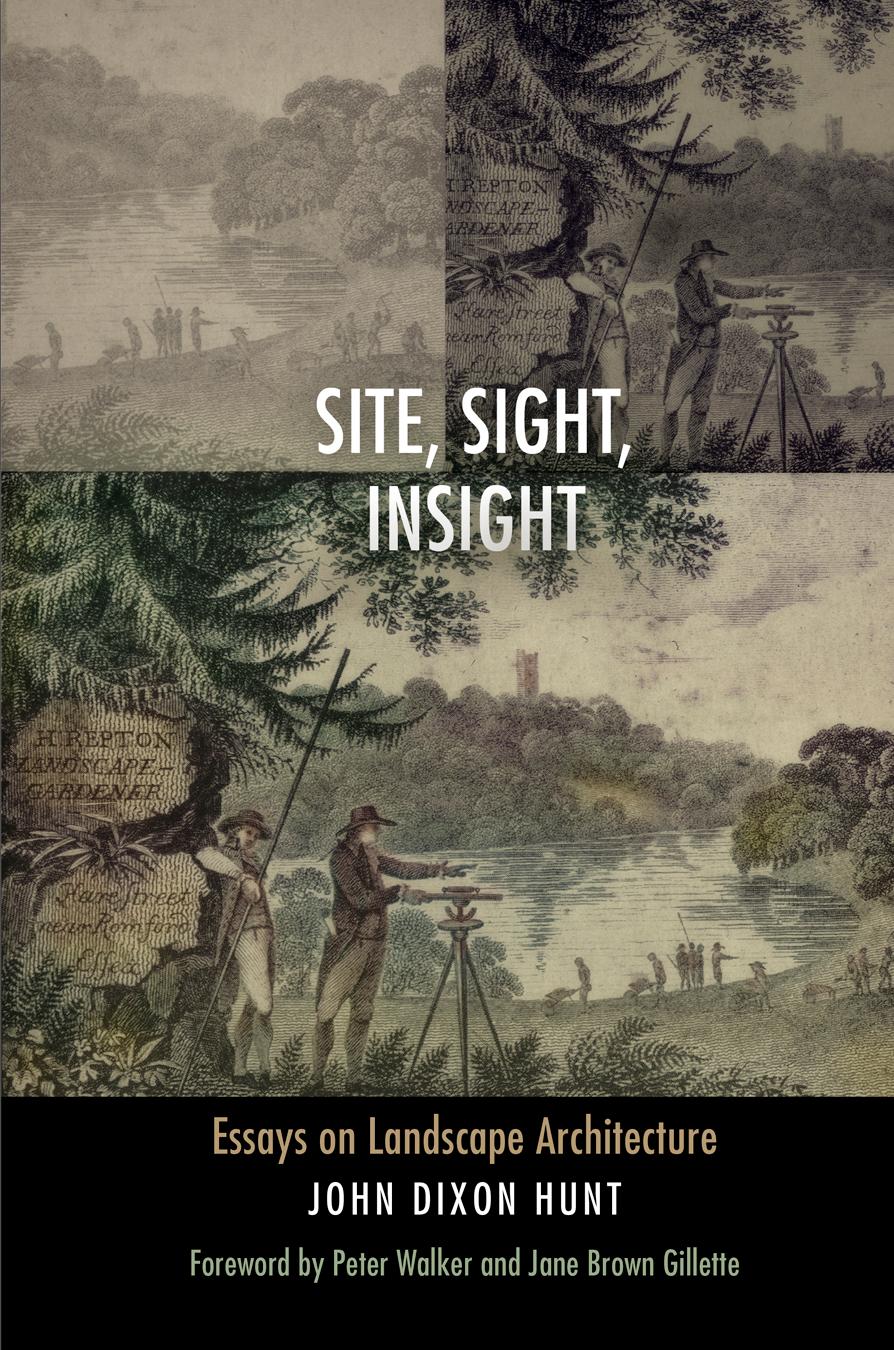
Site, Sight, Insight presents twelve essays by John Dixon Hunt, the leading theorist and historian of landscape architecture. The collection's common theme is a focus on sites, how we see them and what we derive from that looking. Acknowledging that even the most modest landscape encounter has validity, Hunt contends that the more one knows about a site and one's own sight of it (an awareness of how one is seeing), the greater the insight. Employing the concepts, tropes, and rhetorical methods of literary analysis, he addresses the problem of how to discuss, understand, and appreciate places that are experienced through all the senses, over time and through space.
Hunt questions our intellectual and aesthetic understanding of gardens and designed landscapes and asks how these sites affect us emotionally. Do gardens have meaning? When we visit a fine garden or designed landscape, we experience a unique work of great complexity in purpose, which has been executed over a number of years—a work that, occasionally, achieves beauty. While direct experience is fundamental, Hunt demonstrates how the ways in which gardens and landscapes are communicated in word and image can be equally important. He returns frequently to a cluster of key sites and writings on which he has based much of his thinking about garden-making and its role in landscape architecture: the gardens of Rousham in Oxfordshire; Thomas Whately's Observations on Modern Gardening (1770); William Gilpin's dialogues on Stowe (1747); Alexander Pope's meditation on genius loci; the Désert de Retz; Paolo Burgi's Cardada; and the designs by Bernard Lassus and Ian Hamilton Finlay.
Pay easily by card, Klarna, Apple Pay or Google Pay. Not happy? You always have a 14-day money-back guarantee. Read more in our terms. If you have any questions, email us at hello@memmo.org.
Memmo makes studying easier – wherever you are in the world. We bring your course books and smart study tools together in one place: summaries, quizzes, podcasts and flashcards. Plus Ted, your study buddy who answers anything you wonder. Over 50,000 students already study here – built to help you learn faster and stress less.