
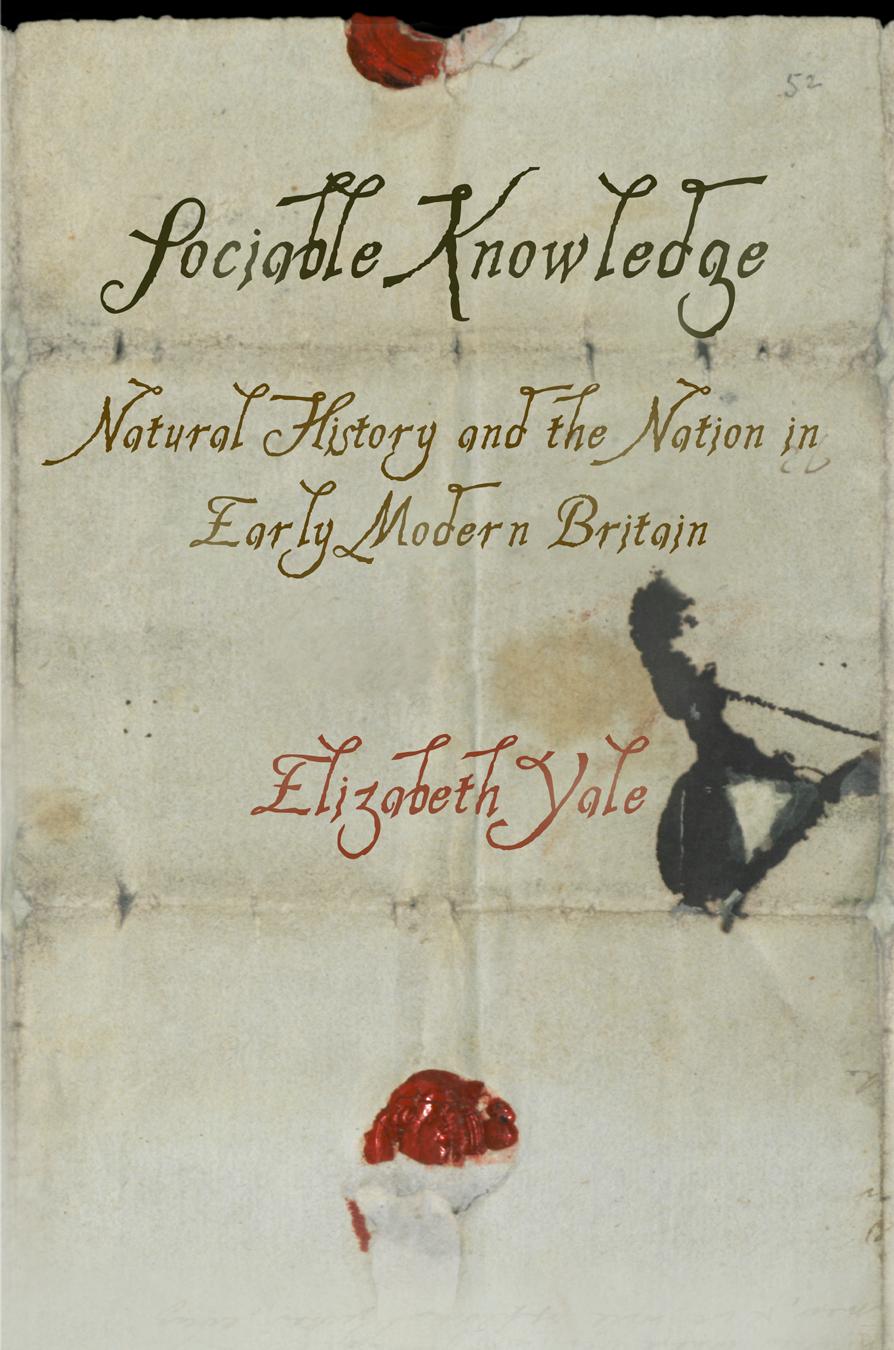
Working with the technologies of pen and paper, scissors and glue, naturalists in early modern England, Scotland, and Wales wrote, revised, and recombined their words, sometimes over a period of many years, before fixing them in printed form. They built up their stocks of papers by sharing these materials through postal and less formal carrier services. They exchanged letters, loose notes, drawings and plans, commonplace books, as well as lengthy treatises, ever-expanding repositories for new knowledge about nature and history as it accumulated through reading, observation, correspondence, and conversation. These textual collections grew alongside cabinets of natural specimens, antiquarian objects, and other curiosities—insects pinned in boxes, leaves and flowers pressed in books, rocks and fossils, ancient coins and amulets, and drafts of stone monuments and inscriptions. The goal of all this collecting and sharing, Elizabeth Yale claims, was to create channels through which naturalists and antiquaries could pool their fragmented knowledge of the hyperlocal and curious into an understanding and representation of Britain as a unified historical and geographical space.
Sociable Knowledge pays careful attention to the concrete and the particular: the manuscript almost lost off the back of the mail carrier's cart, the proper ways to package live plants for transport, the kin relationships through which research questionnaires were distributed. The book shows how naturalists used print instruments to garner financing and content from correspondents and how they relied upon research travel—going out into the field—to make and refresh social connections. By moving beyond an easy distinction between print and scribal cultures, Yale reconstructs not just the collaborations of seventeenth-century practitioners who were dispersed across city and country, but also the ways in which the totality of their exchange practices structured early modern scientific knowledge.
Pay easily by card, Klarna, Apple Pay or Google Pay. Not happy? You always have a 14-day money-back guarantee. Read more in our terms. If you have any questions, email us at hello@memmo.org.
Memmo makes studying easier – wherever you are in the world. We bring your course books and smart study tools together in one place: summaries, quizzes, podcasts and flashcards. Plus Ted, your study buddy who answers anything you wonder. Over 50,000 students already study here – built to help you learn faster and stress less.