
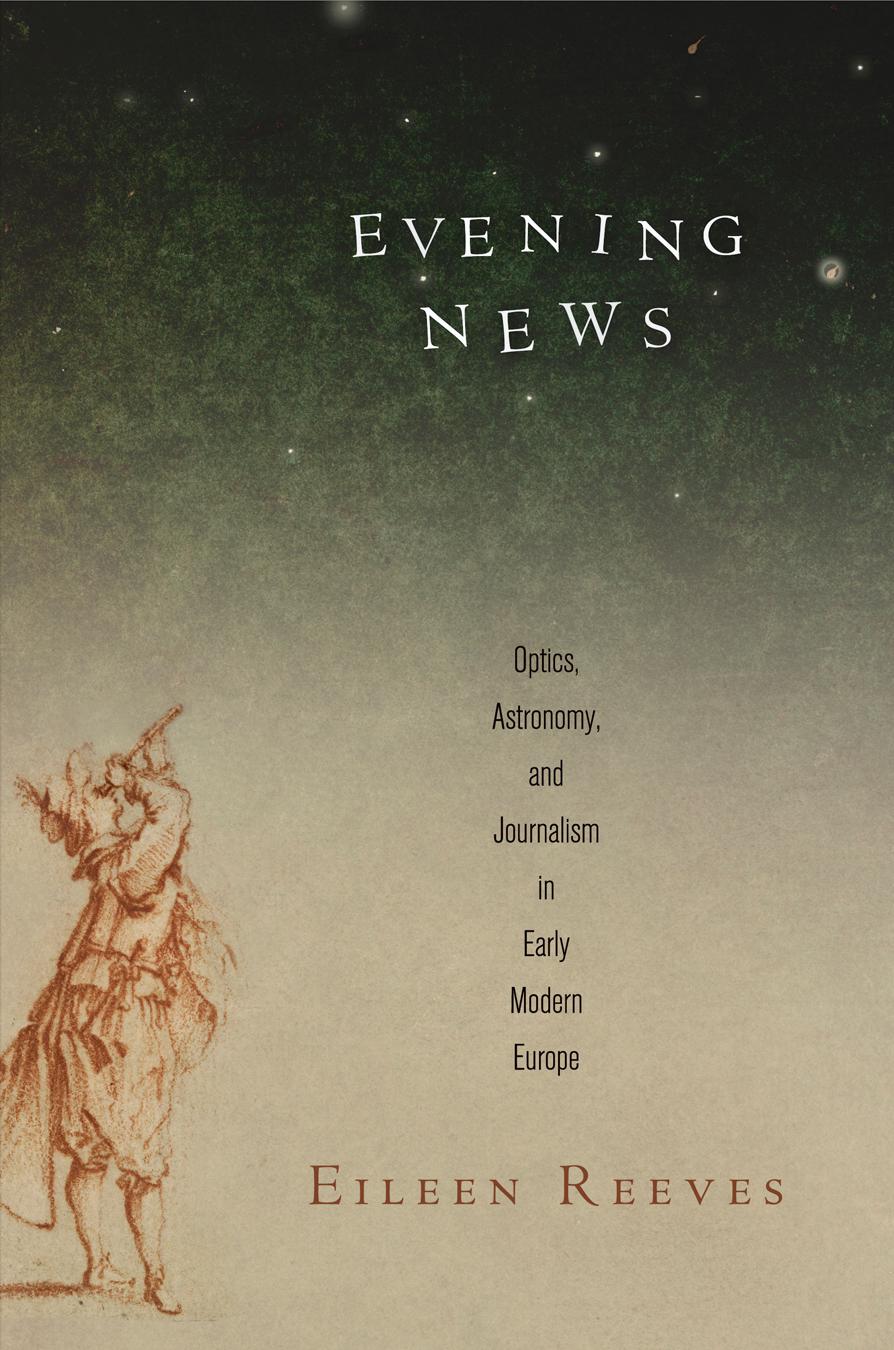
Eileen Reeves examines a web of connections between journalism, optics, and astronomy in early modern Europe, devoting particular attention to the ways in which a long-standing association of reportage with covert surveillance and astrological prediction was altered by the near simultaneous emergence of weekly newsheets, the invention of the Dutch telescope, and the appearance of Galileo Galilei's astronomical treatise, The Starry Messenger.
Early modern news writers and consumers often understood journalistic texts in terms of recent developments in optics and astronomy, Reeves demonstrates, even as many of the first discussions of telescopic phenomena such as planetary satellites, lunar craters, sunspots, and comets were conditioned by accounts of current events. She charts how the deployment of particular technologies of vision—the telescope and the camera obscura—were adapted to comply with evolving notions of objectivity, censorship, and civic awareness. Detailing the differences between various types of printed and manuscript news and the importance of regional, national, and religious distinctions, Evening News emphasizes the ways in which information moved between high and low genres and across geographical and confessional boundaries in the first decades of the seventeenth century.
Pay easily by card, Klarna, Apple Pay or Google Pay. Not happy? You always have a 14-day money-back guarantee. Read more in our terms. If you have any questions, email us at hello@memmo.org.
Memmo makes studying easier – wherever you are in the world. We bring your course books and smart study tools together in one place: summaries, quizzes, podcasts and flashcards. Plus Ted, your study buddy who answers anything you wonder. Over 75,000 students already study here – built to help you learn faster and stress less.