
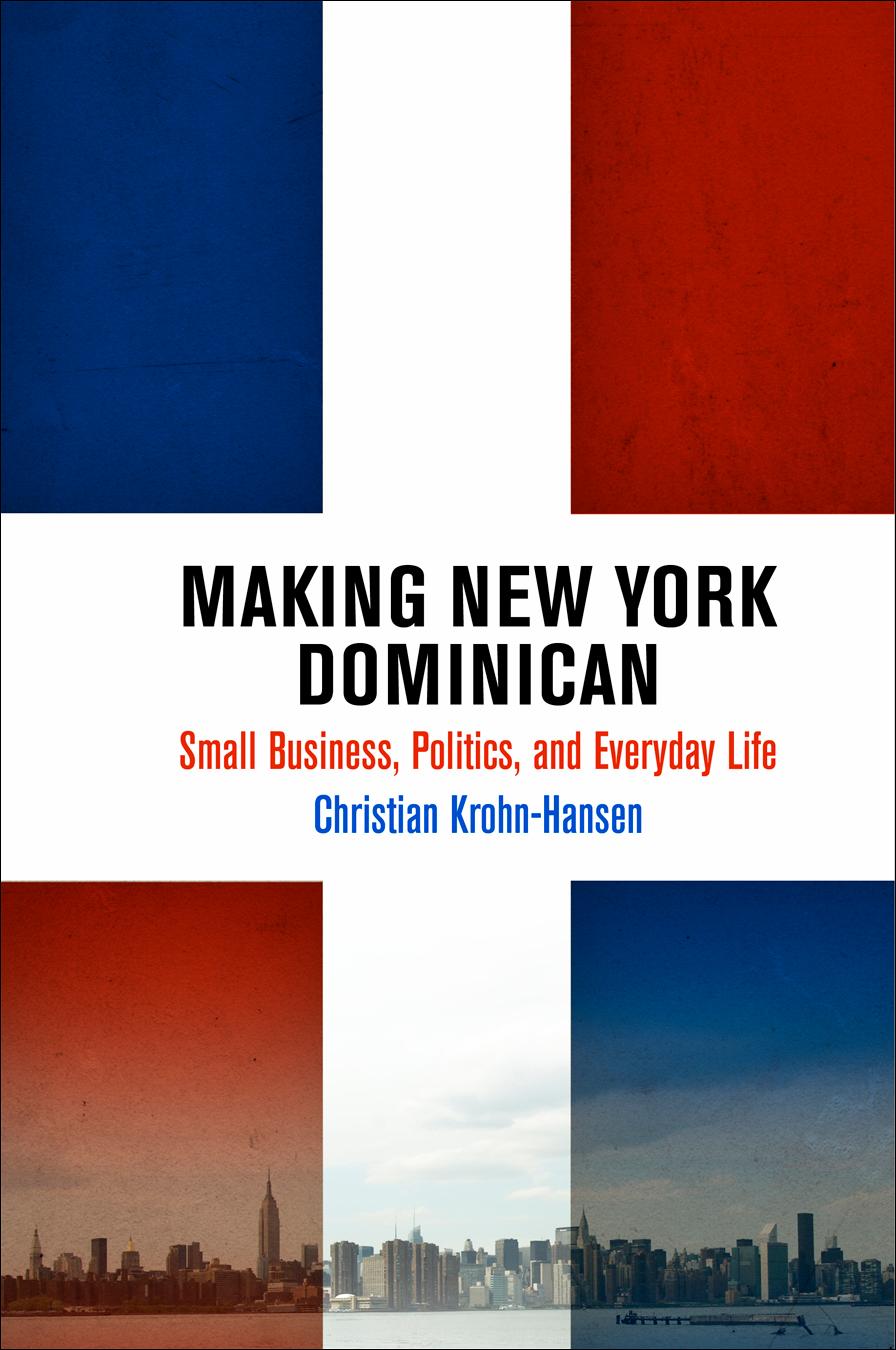
Large-scale emigration from the Dominican Republic began in the early 1960s, with most Dominicans settling in New York City. Since then the growth of the city's Dominican population has been staggering, now accounting for around 7 percent of the total populace. How have Dominicans influenced New York City? And, conversely, how has the move to New York affected their lives? In Making New York Dominican, Christian Krohn-Hansen considers these questions through an exploration of Dominican immigrants' economic and political practices and through their constructions of identity and belonging.
Krohn-Hansen focuses especially on Dominicans in the small business sector, in particular the bodega and supermarket and taxi and black car industries. While studies of immigrant business and entrepreneurship have been predominantly quantitative, using survey data or public statistics, this work employs business ethnography to demonstrate how Dominican enterprises work, how people find economic openings, and how Dominicans who own small commercial ventures have formed political associations to promote and defend their interests. The study shows convincingly how Dominican businesses over the past three decades have made a substantial mark on New York neighborhoods and the city's political economy.
Making New York Dominican is not about a Dominican enclave or a parallel sociocultural universe. It is instead about connections—between Dominican New Yorkers' economic and political practices and ways of thinking and the much larger historical, political, economic, and cultural field within which they operate. Throughout, Krohn-Hansen underscores that it is crucial to analyze four sets of processes: the immigrants' forms of work, their everyday life, their modes of participation in political life, and their negotiation and building of identities. Making New York Dominican offers an original and significant contribution to the scholarship on immigration, the Latinization of New York, and contemporary forms of globalization.
Pay easily by card, Klarna, Apple Pay or Google Pay. Not happy? You always have a 14-day money-back guarantee. Read more in our terms. If you have any questions, email us at hello@memmo.org.
Memmo makes studying easier – wherever you are in the world. We bring your course books and smart study tools together in one place: summaries, quizzes, podcasts and flashcards. Plus Ted, your study buddy who answers anything you wonder. Over 50,000 students already study here – built to help you learn faster and stress less.