
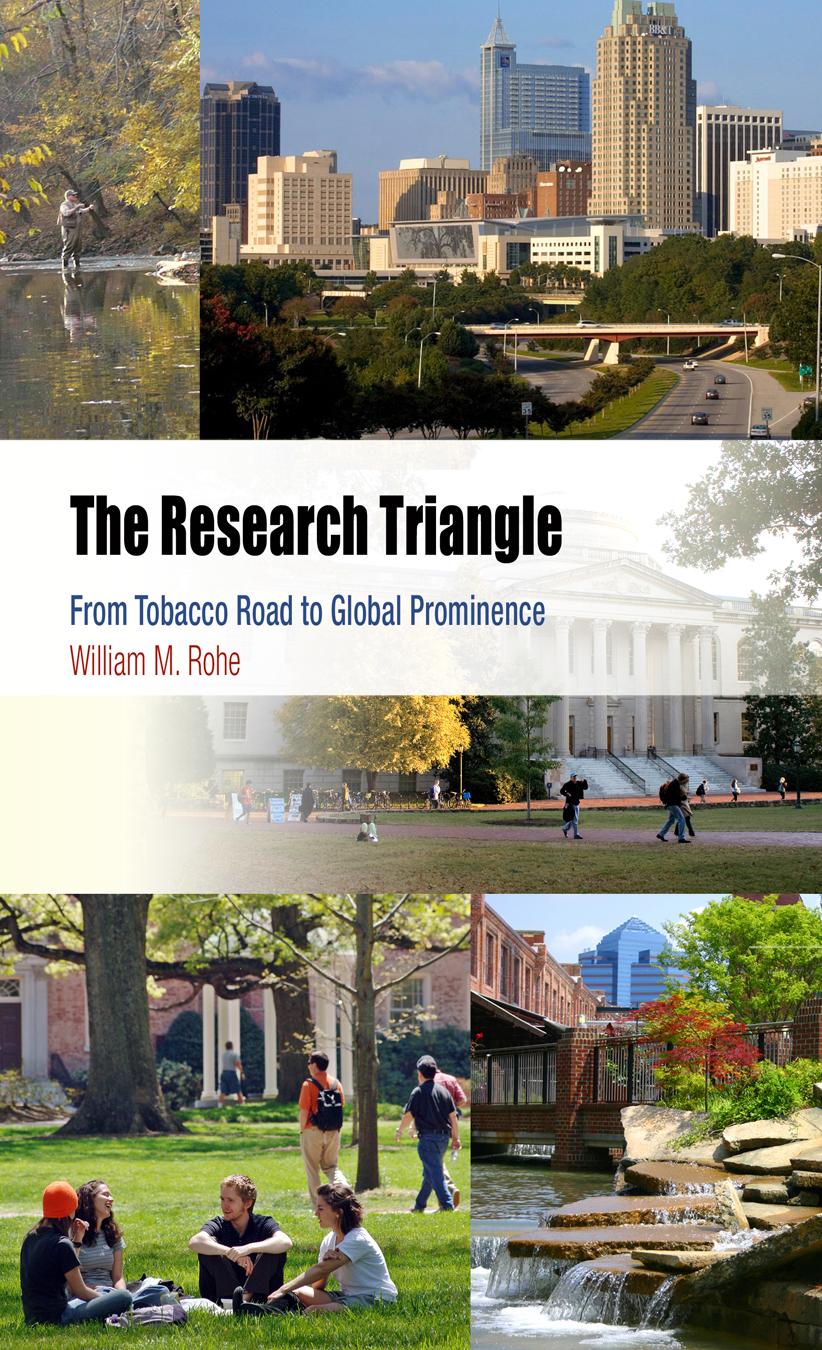
Over the past three decades, the economy of North Carolina's Research Triangle—defined by the cities of Raleigh, Durham, and Chapel Hill—has been transformed from one dependent on agriculture and textiles to one driven by knowledge-based jobs in technology, telecommunications, and pharmaceuticals. Now home to roughly 1.7 million people, the Research Triangle has attracted an influx of new residents from across the country and around the world while continuing to win praise for its high quality of life. At the region's center is the 7,000-acre Research Triangle Park, one of the nation's largest and most prominent research and development campuses. Founded in 1959 through a partnership of local governments, universities, and business leaders, Research Triangle Park has catalyzed the region's rapid growth and hastened its coalescence into a single metropolitan area.
The Research Triangle: From Tobacco Road to Global Prominence describes the history, current challenges, and future prospects of this fascinating metropolitan area. Focusing on the personalities and perspectives of key actors in the development of the region, William M. Rohe traces the emergence of the Research Triangle Park and its role in the region's economic transformation. He also addresses some of the downsides of development, illustrating the strains that explosive population growth has placed on the region's school systems, natural resources, transportation infrastructure, and social cohesion. As Rohe shows, the Research Triangle is not a city in the traditional sense but a sprawling conurbation whose rapid, low-density growth and attendant problems are indicative of metropolitan life in much of America today. Although the Triangle's short-term prospects are bright, Rohe warns that troubling issues loom—the region is expected to add nearly a million residents over the next two decades—and will need to be addressed through improvements in governmental cooperation, regional planning, and civic leadership. Finally, the author outlines key lessons that other metropolitan areas can learn from the Research Triangle's dramatic rise to prominence.
Pay easily by card, Klarna, Apple Pay or Google Pay. Not happy? You always have a 14-day money-back guarantee. Read more in our terms. If you have any questions, email us at hello@memmo.org.
Memmo makes studying easier – wherever you are in the world. We bring your course books and smart study tools together in one place: summaries, quizzes, podcasts and flashcards. Plus Ted, your study buddy who answers anything you wonder. Over 75,000 students already study here – built to help you learn faster and stress less.