
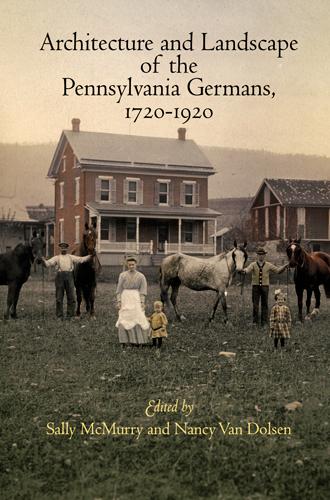
The phrase "Pennsylvania German architecture" likely conjures images of either the "continental" three-room house with its huge hearth and five-plate stoves, or the huge Pennsylvania bank barn with its projecting overshoot. These and other trademarks of Pennsylvania German architecture have prompted great interest among a wide audience, from tourists and genealogists to architectural historians, antiquarians, and folklorists. Since the nineteenth century, scholars have engaged in field measurement and drawing, photographic documentation, and careful observation, resulting in a scholarly conversation about Pennsylvania German building traditions. What cultural patterns were being expressed in these buildings? How did shifting social, technological, and economic forces shape architectural changes? Since those early forays, our understanding has moved well beyond the three-room house and the forebay barn.
In Architecture and Landscape of the Pennsylvania Germans, 1720-1920, eight essays by leading scholars and preservation professionals not only describe important architectural sites but also offer original interpretive insights that will help advance understanding of Pennsylvania German culture and history. Pennsylvania Germans' lives are traced through their houses, barns, outbuildings, commercial buildings, churches, and landscapes. The essays bring to bear years of field observation as well as engagement with current scholarly perspectives on issues such as the nature of "ethnicity," the social construction of landscape, and recent historiography about the Pennsylvania Germans. Dozens of original measured drawings, appearing here for the first time in print, document important works of Pennsylvania German architecture, including the iconic Bertolet barns in Berks County, the Martin Brandt farm complex in Cumberland County, a nineteenth-century Pennsylvania German housemill, and urban houses in Lancaster.
Pay easily by card, Klarna, Apple Pay or Google Pay. Not happy? You always have a 14-day money-back guarantee. Read more in our terms. If you have any questions, email us at hello@memmo.org.
Memmo makes studying easier – wherever you are in the world. We bring your course books and smart study tools together in one place: summaries, quizzes, podcasts and flashcards. Plus Ted, your study buddy who answers anything you wonder. Over 75,000 students already study here – built to help you learn faster and stress less.