
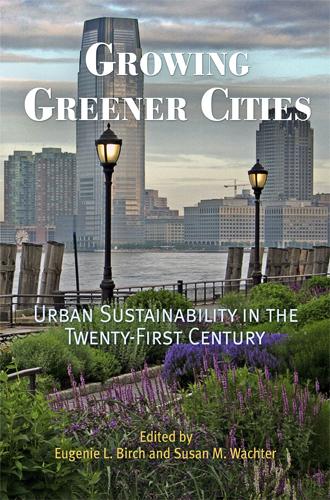
Nineteenth-century landscape architect Frederick Law Olmsted described his most famous project, the design of New York's Central Park, as "a democratic development of highest significance." Over the years, the significance of green in civic life has grown. In twenty-first-century America, not only open space but also other issues of sustainability—such as potable water and carbon footprints—have become crucial elements in the quality of life in the city and surrounding environment. Confronted by a U.S. population that is more than 70 percent urban, growing concern about global warming, rising energy prices, and unabated globalization, today's decision makers must find ways to bring urban life into balance with the Earth in order to sustain the natural, economic, and political environment of the modern city.
In Growing Greener Cities, a collection of essays on urban sustainability and environmental issues edited by Eugenie L. Birch and Susan M. Wachter, scholars and practitioners alike promote activities that recognize and conserve nature's ability to sustain urban life. These essays demonstrate how partnerships across professional organizations, businesses, advocacy groups, governments, and individuals themselves can bring green solutions to cities from London to Seattle. Beyond park and recreational spaces, initiatives that fall under the green umbrella range from public transit and infrastructure improvement to aquifer protection and urban agriculture.
Growing Greener Cities offers an overview of the urban green movement, case studies in effective policy implementation, and tools for measuring and managing success. Thoroughly illustrated with color graphs, maps, and photographs, Growing Greener Cities provides a panoramic view of urban sustainability and environmental issues for green-minded city planners, policy makers, and citizens.
Pay easily by card, Klarna, Apple Pay or Google Pay. Not happy? You always have a 14-day money-back guarantee. Read more in our terms. If you have any questions, email us at hello@memmo.org.
Memmo makes studying easier – wherever you are in the world. We bring your course books and smart study tools together in one place: summaries, quizzes, podcasts and flashcards. Plus Ted, your study buddy who answers anything you wonder. Over 75,000 students already study here – built to help you learn faster and stress less.