
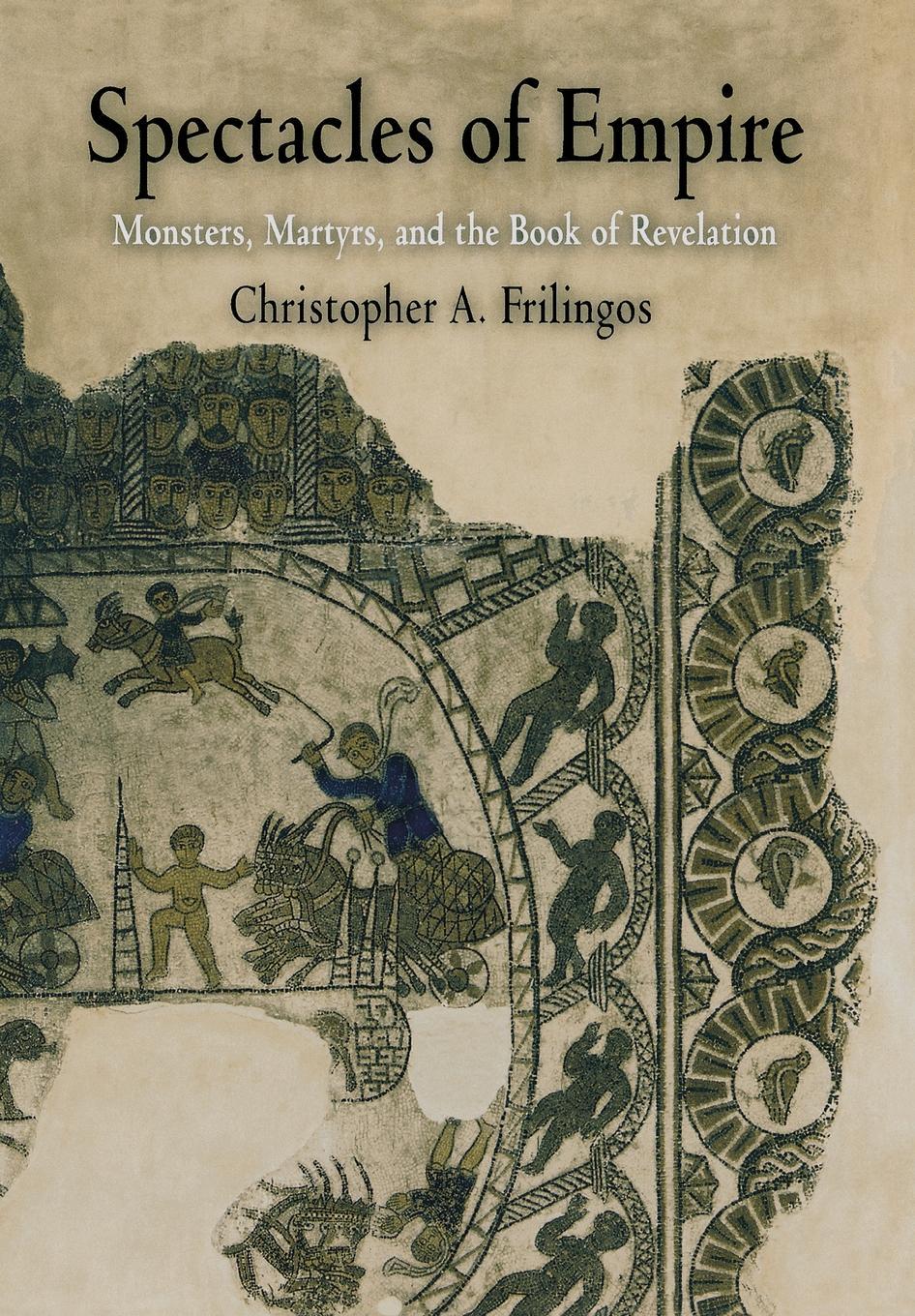
The book of Revelation presents a daunting picture of the destruction of the world, complete with clashing gods, a multiheaded beast, armies of heaven, and the final judgment of mankind. The bizarre conclusion to the New Testament is routinely cited as an example of the early Christian renunciation of the might and values of Rome. But Christopher A. Frilingos contends that Revelation's relationship to its ancient environment was a rather more complex one. In Spectacles of Empire he argues that the public displays of the Roman Empire—the games of the arena, the execution of criminals, the civic veneration of the emperor—offer a plausible context for reading Revelation. Like the spectacles that attracted audiences from one end of the Mediterranean Sea to the other, Revelation shares a preoccupation with matters of spectatorship, domination, and masculinity.
Scholars have long noted that in promising a complete reversal of fortune to an oppressed minority, Revelation has provided inspiration to Christians of all kinds, from liberation theologians protesting globalization to the medieval Apostolic Brethren facing death at the stake. But Frilingos approaches the Apocalypse from a different angle, arguing that Revelation was not merely a rejection of the Roman world in favor of a Christian one; rather, its visions of monsters and martyrs were the product of an empire whose subjects were trained to dominate the threatening "other." By comparing images in Revelation to those in other Roman-era literature, such as Greek romances and martyr accounts, Frilingos reveals a society preoccupied with seeing and being seen. At the same time, he shows how Revelation calls attention to both the risk and the allure of taking in a show in a society which emphasized the careful scrutiny of one's friends, enemies, and self. Ancient spectators, Frilingos notes, whether seated in an arena or standing at a distance as Babylon burned, frequently discovered that they themselves had become part of the performance.
Pay easily by card, Klarna, Apple Pay or Google Pay. Not happy? You always have a 14-day money-back guarantee. Read more in our terms. If you have any questions, email us at hello@memmo.org.
Memmo makes studying easier – wherever you are in the world. We bring your course books and smart study tools together in one place: summaries, quizzes, podcasts and flashcards. Plus Ted, your study buddy who answers anything you wonder. Over 75,000 students already study here – built to help you learn faster and stress less.