
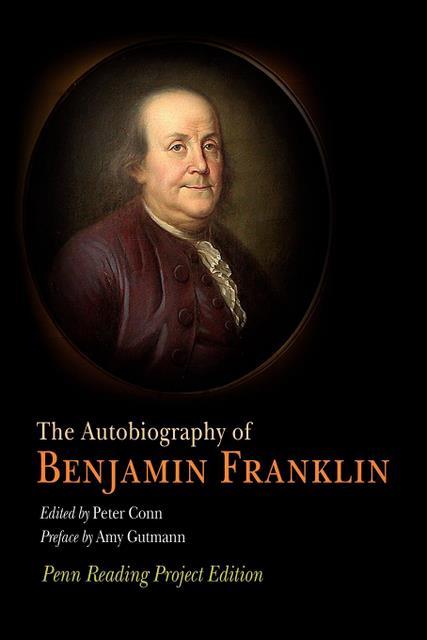
Printer and publisher, author and educator, scientist and inventor, statesman and philanthropist, Benjamin Franklin was the very embodiment of the American type of self-made man. In 1771, at the age of 65, he sat down to write his autobiography, "having emerged from the poverty and obscurity in which I was born and bred to a state of affluence and some degree of reputation in the world, and having gone so far through life with a considerable share of felicity." The result is a classic of American literature.
On the eve of the tercentenary of Franklin's birth, the university he founded has selected the Autobiography for the Penn Reading Project. Each year, for the past fifteen years, the University of Pennsylvania has chosen a single work that the entire incoming class, and a large segment of the faculty and staff, read and discuss together. For this occasion the University of Pennsylvania Press will publish a special edition of Franklin's Autobiography, including a new preface by University president Amy Gutmann and an introduction by distinguished scholar Peter Conn. The volume will also include four short essays by noted Penn professors as well as a chronology of Franklin's life and the text of Franklin's Proposals Relating to the Education of Youth in Pennsylvania, a document resulting in the establishment of an institution of higher education that ultimately became the University of Pennsylvania.
No area of human endeavor escaped Franklin's keen attentions. His ideas and values, as Amy Gutmann notes in her remarks, have shaped the modern University of Pennsylvania profoundly, "more profoundly than have the founders of any other major university of college in the United States." Franklin believed that he had been born too soon. Readers will recognize that his spirit lives on at Penn today.
Essay contributors: Richard R. Beeman, Paul Guyer, Michael Weisberg, and Michael Zuckerman.
Pay easily by card, Klarna, Apple Pay or Google Pay. Not happy? You always have a 14-day money-back guarantee. Read more in our terms. If you have any questions, email us at hello@memmo.org.
Memmo makes studying easier – wherever you are in the world. We bring your course books and smart study tools together in one place: summaries, quizzes, podcasts and flashcards. Plus Ted, your study buddy who answers anything you wonder. Over 50,000 students already study here – built to help you learn faster and stress less.