
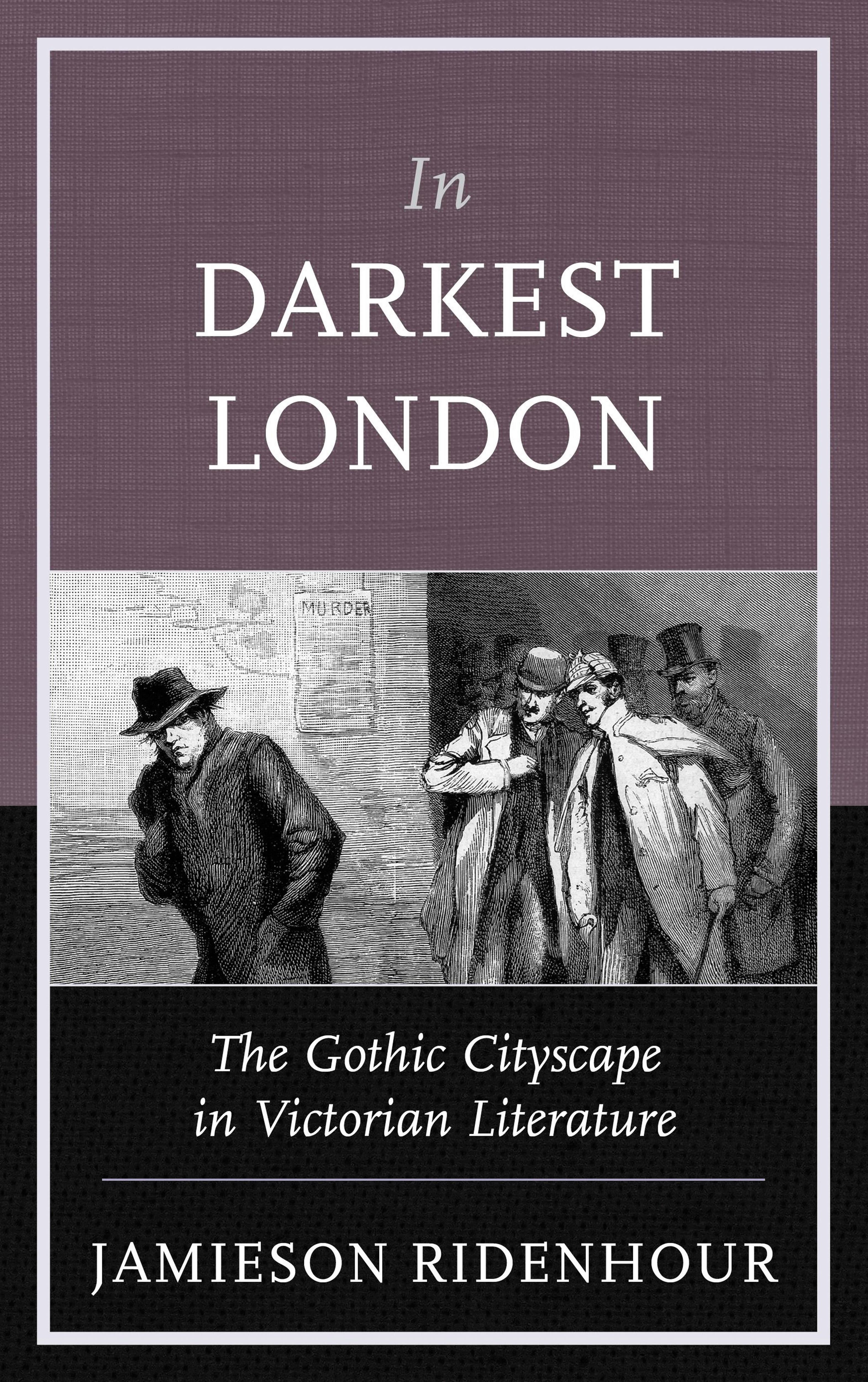
During the 19th century, London was a complex, vibrant, and multi-faceted city, the first true metropolis. As such, it contained within it a widely disparate array of worlds and cultures. Representations of London in literature varied just as widely. In the late 1830s, London began appearing as a site of literary terror, and by the end of the century a large proportion of the important Victorian “Gothic revival” novels were set in the city: The Strange Case of Dr. Jekyll and Mr. Hyde, The Picture of Dorian Gray, The Three Impostors, The Beetle, Dracula, and many others.
In Darkest London is a full-length study of the Victorian Urban Gothic, a pervasive mode that appears not only in straightforward novels of terror like those mentioned above but also in the works of mainstream authors such as Charles Dickens and in the journalism and travel literature of the time. In this volume, author Jamieson Ridenhour looks beyond broad considerations of the Gothic as a historical mode to explore the development of London and the concurrent rise of the Urban Gothic. He also considers very specific aspects of London’s representation in these works and draws upon recent and then-contemporary theories, close readings of relevant texts, and cartography to support and expand these ideas.
This book examines the work of both canonical and non-canonical authors, including Dickens, Bram Stoker, Robert Louis Stevenson, G.W.M. Reynolds, Richard Marsh, Arthur Machen, Marie Belloc Lowndes, and Oscar Wilde. Placing the conventions of the Gothic form in their proper historical context, In Darkest London will appeal to scholars and students interested in an in-depth survey of the Urban Gothic.
In Darkest London is a full-length study of the Victorian Urban Gothic, a pervasive mode that appears not only in straightforward novels of terror like those mentioned above but also in the works of mainstream authors such as Charles Dickens and in the journalism and travel literature of the time. In this volume, author Jamieson Ridenhour looks beyond broad considerations of the Gothic as a historical mode to explore the development of London and the concurrent rise of the Urban Gothic. He also considers very specific aspects of London’s representation in these works and draws upon recent and then-contemporary theories, close readings of relevant texts, and cartography to support and expand these ideas.
This book examines the work of both canonical and non-canonical authors, including Dickens, Bram Stoker, Robert Louis Stevenson, G.W.M. Reynolds, Richard Marsh, Arthur Machen, Marie Belloc Lowndes, and Oscar Wilde. Placing the conventions of the Gothic form in their proper historical context, In Darkest London will appeal to scholars and students interested in an in-depth survey of the Urban Gothic.
Pay easily by card, Klarna, Apple Pay or Google Pay. Not happy? You always have a 14-day money-back guarantee. Read more in our terms. If you have any questions, email us at hello@memmo.org.
Memmo makes studying easier – wherever you are in the world. We bring your course books and smart study tools together in one place: summaries, quizzes, podcasts and flashcards. Plus Ted, your study buddy who answers anything you wonder. Over 50,000 students already study here – built to help you learn faster and stress less.