
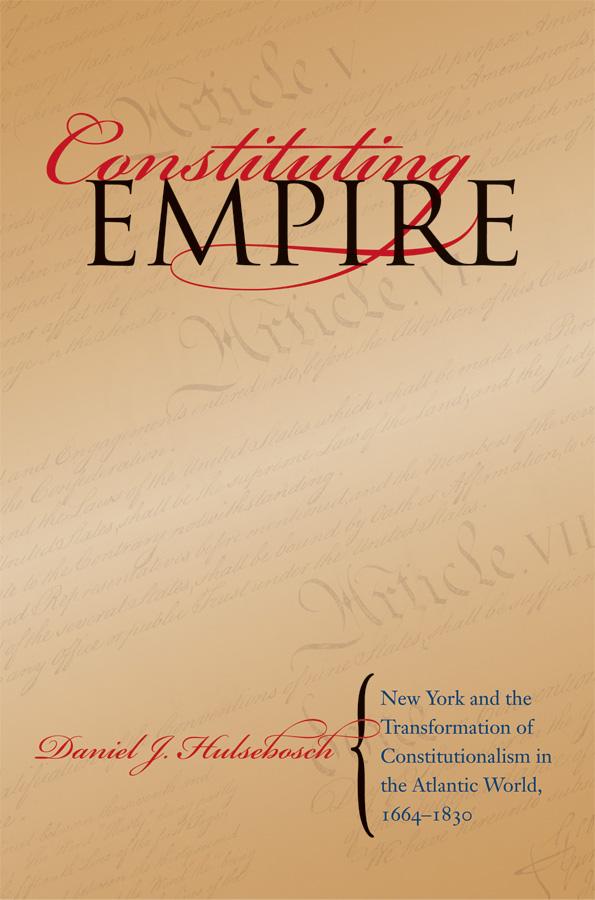
According to the traditional understanding of American constitutional law, the Revolution produced a new conception of the constitution as a set of restrictions on the power of the state rather than a mere description of governmental roles. Daniel J. Hulsebosch complicates this viewpoint by arguing that American ideas of constitutions were based on British ones and that, in New York, those ideas evolved over the long eighteenth century as New York moved from the periphery of the British Atlantic empire to the center of a new continental empire.
Hulsebosch explains how colonists and administrators reconfigured British legal sources to suit their needs in an expanding empire. In this story, familiar characters such as Alexander Hamilton and James Kent appear in a new light as among the nation’s most important framers, and forgotten loyalists such as Superintendent of Indian Affairs Sir William Johnson and lawyer William Smith Jr. are rightly returned to places of prominence.
In his paradigm-shifting analysis, Hulsebosch captures the essential paradox at the heart of American constitutional history: the Revolution, which brought political independence and substituted the people for the British crown as the source of legitimate authority, also led to the establishment of a newly powerful constitution and a new postcolonial genre of constitutional law that would have been the envy of the British imperial agents who had struggled to govern the colonies before the Revolution.
Hulsebosch explains how colonists and administrators reconfigured British legal sources to suit their needs in an expanding empire. In this story, familiar characters such as Alexander Hamilton and James Kent appear in a new light as among the nation’s most important framers, and forgotten loyalists such as Superintendent of Indian Affairs Sir William Johnson and lawyer William Smith Jr. are rightly returned to places of prominence.
In his paradigm-shifting analysis, Hulsebosch captures the essential paradox at the heart of American constitutional history: the Revolution, which brought political independence and substituted the people for the British crown as the source of legitimate authority, also led to the establishment of a newly powerful constitution and a new postcolonial genre of constitutional law that would have been the envy of the British imperial agents who had struggled to govern the colonies before the Revolution.
Pay easily by card, Klarna, Apple Pay or Google Pay. Not happy? You always have a 14-day money-back guarantee. Read more in our terms. If you have any questions, email us at hello@memmo.org.
Memmo makes studying easier – wherever you are in the world. We bring your course books and smart study tools together in one place: summaries, quizzes, podcasts and flashcards. Plus Ted, your study buddy who answers anything you wonder. Over 50,000 students already study here – built to help you learn faster and stress less.
You might also like
Buy the book0